2026 Brazilian presidential election
General elections held in Brazil on October 4, 2026, featuring a presidential runoff between incumbent Luiz Inácio Lula da Silva and senator Flávio Bolsonaro.
Also known as: 2026 Brazilian general election
Overview
General elections were held in Brazil on October 4, 2026, to elect the president, vice president, members of the National Congress, governors, vice governors, and legislative assemblies. Because no presidential candidate received more than 50% of the valid votes in the first round, a runoff election was scheduled for October 25, 2026.
Candidates and First Round
In the first round, senator Flávio Bolsonaro of Rio de Janeiro—the eldest son of former president Jair Bolsonaro—led with 47% of the vote, narrowly ahead of incumbent president Luiz Inácio Lula da Silva, who secured 45%. The gap between the two candidates was exceptionally narrow, recorded at less than 2% of the vote.
Runoff Campaign
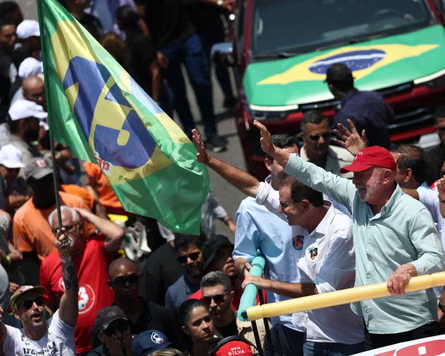
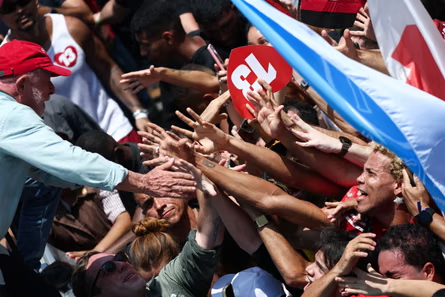
The runoff campaign featured a highly competitive and polarized contest between Lula, representing the Workers' Party (PT), and the far-right senator Flávio Bolsonaro. Key issues during the campaign included voter turnout and abstention rates, economic conditions, public security proposals, and the broader political trajectory of democratic institutions in Brazil.
Related translated reports
Brazil chooses between Lula and Flávio Bolsonaro in razor-thin presidential runoff
Brazilian voters are deciding a closely contested runoff between President Luiz Inácio Lula da Silva and senator Flávio Bolsonaro after Bolsonaro narrowly won the first round. Polls showed the candidates nearly tied before voting, with turnout, security, democracy and the Bolsonaro family’s political legacy central to the campaign.
Brazil is voting in a presidential runoff expected to be decided by a narrow margin, with leftist incumbent Luiz Inácio Lula da Silva seeking to recover from a first-round defeat to far-right senator Flávio Bolsonaro. Bolsonaro entered the runoff with momentum after unexpectedly finishing first in the opening round despite trailing in most polls. His advantage, however, narrowed over the following three weeks as Lula recovered ground, leaving the two candidates virtually level before Sunday’s vote. The first-round gap was less than 2 percentage points, the smallest ever recorded in a Brazilian presidential first round. For Lula, 80, a major focus of the runoff has been persuading supporters to vote after abstention reached a record level in the first round and disproportionately affected his electorate. His campaign has also warned about the consequences of returning the Bolsonaro family to national power. Flávio Bolsonaro, 45, spent more than two decades as a congressman and passed relatively few bills. He is the eldest son of former president Jair Bolsonaro, who is under house arrest while serving a 27-year sentence for attempting a coup aimed at reversing his 2022 election defeat to Lula. After casting his ballot on Sunday morning at a school in Rio de Janeiro’s north zone, Bolsonaro said the country needed significant change and argued that living conditions had deteriorated. Lula voted in São Bernardo do Campo, the industrial city where his political career began almost 50 years ago. He praised the pro-Lula demonstrations that spread during the runoff, many of them organised independently by young people, and said he was confident voters would reject Bolsonaro. If elected, Bolsonaro has said he would pardon his father. With a more conservative congress due to take office next year, he has also pledged to change the constitution and, in his words, “re-democratise this country”, alarming opponents who fear he could adopt an authoritarian approach similar to that associated with his father. The stark contrast between the two candidates was reflected among voters. Nuno Rau, 63, an architect and writer, said he viewed the election as a choice between fundamentally different national projects. Although he said he had criticisms of Lula, he argued that Bolsonaro represented a threat to social rights and democracy, while Lula had supported income redistribution and free public education. Aparecida Moreira, a 62-year-old lawyer, said she intended to back Bolsonaro largely because of his tougher security proposals. Those plans include building five “mega-prisons” modelled on prisons introduced under El Salvador’s populist autocrat Nayib Bukele. Moreira also backed Bolsonaro’s proposal for chemical castration of rapists and said voting for Lula would amount to supporting supreme court justice Alexandre de Moraes, whom Bolsonaro supporters closely associate with Lula even though Lula did not appoint him. Moraes oversaw Jair Bolsonaro’s conviction. Both Lula and Flávio Bolsonaro attracted large crowds at their final rallies on Saturday in Rio de Janeiro, São Paulo and Belo Horizonte. The campaign was also marked by violence. In northern Minas Gerais, Iara Pimentel, a councillor from Lula’s party, suffered facial injuries and was hospitalised after Bolsonaro supporters threw glass bottles and bricks at the motorcade in which she was travelling. After leaving hospital, she said attacks on people for expressing political views were unacceptable. With support for both candidates largely fixed, the outcome is expected to depend heavily on the relatively small group of voters who identify with neither side. Bolsonaro started the runoff ahead and secured backing from most defeated first-round candidates, but his polling numbers then stopped growing. Some analysts attributed that stagnation to renewed public concern over another Bolsonaro presidency and to controversies surrounding the senator, who is being investigated in two federal police inquiries involving alleged corruption and money laundering. Lula, meanwhile, overhauled his digital campaign and benefited from student-led demonstrations across Brazil, many of which were organised without his direct involvement. Political scientist Helcimara de Souza Telles said Lula’s first-round campaign had struggled to connect with voters, while civil society movements became an important force behind his improvement during the runoff. The last polls released on Saturday still showed Bolsonaro marginally ahead. Brazil has an electorate of 159 million, and the final result is expected late Sunday evening. Analysts widely expect the contest to be extremely close regardless of the winner. Some analysts have also raised the possibility that Bolsonaro could refuse to concede if Lula reverses the first-round result, following the example of his father four years earlier. They have further suggested that US President Donald Trump, a longstanding ally of the Bolsonaro family, might decline to recognise the outcome. Telles accused Trump of seeking to “colonise” Latin America in pursuit of US interests. She noted that rightwing candidates had won all seven presidential elections held in the region since Trump began his second term and described Brazil as one of the few remaining countries offering resistance to the US president. In her assessment, a Bolsonaro victory would mean Brazil moving toward what she described as a US-backed model of autocracy.