Flamingo Revolution
A decentralised protest movement in Albania that began against luxury resort development in protected coastal areas and later expanded into anti-government demonstrations.
Also known as: Revolucioni i Flamingove
Overview
The Flamingo Revolution (Albanian: Revolucioni i Flamingove) is a decentralised protest movement in Albania. It began as opposition to luxury tourism development in protected coastal areas, including proposals associated with the Sazan Island and Zvërnec resort project backed by Jared Kushner, a US investor and son-in-law of Donald Trump. The movement later broadened into demonstrations against the government of Prime Minister Edi Rama.
Origins
Initial protests were reported in Baks-Rrjoll against the planned Blue Borgo resort and disputed land ownership. A larger wave followed on 16 May at Zvërnec, near the Narta Lagoon, over preparatory works and proposed developments linked to the Sazan Island and Zvërnec resort project. Violence against protesters near the project site on 30 May triggered further demonstrations in Tirana, and protests spread to other cities in Albania, Kosovo and Albanian diaspora communities.
Escalation
Students became prominent in the unrest in Tirana, where they clashed with riot police. Reports described ministerial buildings, banks, businesses and a police station being set on fire, attacked or looted, while police used rubber bullets and tear gas to disperse crowds. Protesters used the slogan “Albania is not for sale”. Among reported demands were Rama’s resignation and the formation of a non-partisan technical government; Rama refused to resign and said the government would listen to young people.
Environmental and EU context
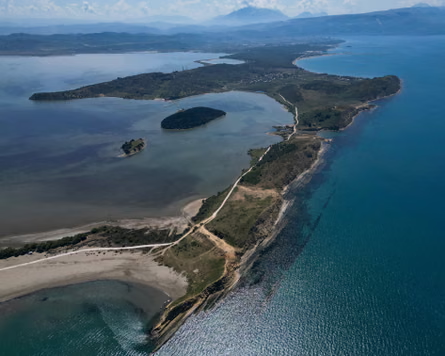
The controversy centred on construction in formerly protected coastal areas, including parts of the Vjosa-Narta landscape described as surrounding the last intact delta system in the Mediterranean. Reports said the project foresaw up to 10,000 villas in coastal areas. The government had passed a law allowing “strategic investors” to build in parts of the landscape, and critics accused it of fast-tracking the project before EU accession rules applied. Protests intensified after reports that ancient dunes and forest were destroyed to create access roads in the reserve. The European Parliament called for repeal of the law, saying it threatened environmental standards that are non-negotiable for EU candidate countries.
Related translated reports
Albania accused of rushing through Trump-linked resort in formerly protected landscape
Dutch MEP says government is trying to avoid EU environmental rules as protests over luxury development turn violent MEPs have accused Albania of deploying “sneaky” practices to fast-track a proposed Trump-linked luxury resort in the country amid protests that have turned increasingly violent. As the prime minister, Edi Rama, pledged to “listen to the voices of young people” taking to the streets, there was mounting criticism of his failure to address demonstrators who had long opposed the controversial project peacefully. Continue reading...
MEPs have accused Albania of deploying “sneaky” practices to fast-track a proposed Trump-linked luxury resort in the country amid protests that have turned increasingly violent. As the prime minister, Edi Rama, pledged to “listen to the voices of young people” taking to the streets, there was mounting criticism of his failure to address demonstrators who had long opposed the controversial project peacefully. In scenes not seen in decades, students now leading the unrest have fought pitched battles with riot police in Tirana as ministerial buildings, banks and businesses have been set ablaze, attacked and looted. Speaking to the Guardian, the Dutch MEP Tineke Strik accused Rama of inflaming the situation by doggedly pursuing plans championed by the US president’s son-in-law Jared Kushner . “If the Albanian government had taken the ‘Flamingo Revolution’ seriously we wouldn’t be here,” she said of the popular movement launched in response to the resort being built in ecologically sensitive areas of the Balkan state. “The students are voicing the frustration of people who feel that they haven’t been listened to.” On Monday, municipal workers could be seen removing paving stones as shopkeepers secured premises with metal sheeting following a sixth consecutive day of violent clashes in the capital in which protestors also set fire to a police station. Riot police responded with rubber bullets and tear gas as they attempted to disperse the crowds. Students have vowed to continue demonstrating until the socialist leader resigns – a demand he has resolutely refused to meet. “This terrible resort idea was the match that lit this fire,” sighed Greta, a student in Tirana, adding that the slogan chanted by young people attending demonstrations for months had been “Albania is not for sale”. “Now there are other issues that are whipping up the flames. We actually really care about the state of our democracy, about living standards, about education.” The controversial project foresees construction of up to 10,000 villas in coastal areas that were environmentally protected until the government passed a contentious law allowing “strategic investors” to build in parts of the Vjosa-Narta landscape surrounding the last intact delta system in the Mediterranean. In June, the European parliament called for the legislation to be repealed by the EU candidate country, saying it posed a direct threat to environmental standards that are “non-negotiable conditions of accession”. The parliament’s move came after construction workers broke ground in May, igniting protests that would spread nationwide after it was discovered that ancient dunes and forest had been destroyed to create access roads in the nature reserve. Re-elected for a historic fourth term last year, Rama is on a mission to get the Balkan state – still one of Europe’s poorest after the collapse of communism more than three decades ago – into the 27-member bloc by 2030. In a live address delivered on social media on Sunday he said: “Albanians need to think very clearly: do they want this, do they want that, or do they want the EU?” But Strik, a Greens group MEP who led a European parliament fact-finding mission to Albania in June, said it was clear the government was also rushing to “create facts on the ground” before it was bound by EU standards. A frontrunner in the enlargement process, Albania hopes to wrap up accession talks by the end of 2027. Citing an environmental impact study whose “scientific results” Rama recently described as key to the €4bn project going ahead, she said: “The government has submitted an environmental package to the [EU] Commission but without repealing the law allowing for construction in the protected area … it is still trying to help realise the megalomaniacal luxury resort plans of Ivanka Trump and Jared Kushner. How? By conducting a fast-track impact assessment which, if [more comprehensively] done, could never lead to the conclusion that this construction is allowed.” Rama told a tourism forum in Brussels this month that the milestone development would be a gamechanger for a nation that had been the “North Korea” of Europe before the fall of its Stalinist regime in the 1990s. “If construction goes ahead this will be decided not in the streets but by science,” he told the forum. “The idea that nature will take care of itself, if we simply look at it, is preposterous and old. We are trying to come out with … a [high-end] destination where nature will be highlighted and where people will holiday, and where the Albanian people will get back what they deserve: a much stronger economy.” On 8 October, Kushner described the venture as having a single goal: “To build to the highest design and environmental standards and leave this extraordinary part of Albania greener, more biodiverse and environmentally stronger”. Private contractors, tasked with implementing the impact study, have been seen mapping, measuring and monitoring the area, prompting environmentalists, who had initially spearheaded the protests, to counter this week that “science had already spoken”. “It spoke when experts from the faculty of science at Tirana University elected to protect this incredible landscape in 2004,” said Aleksander Trajce at the country’s oldest conservation group, the Protection and Preservation of the Natural Environment in Albania (PPNEA). “Their decision was based on very sound scientific data. There’s no way that science can tell us more. Reopening the discussion is not only disingenuous but clearly a way to justify construction that should not be happening at all.” Insisting an environmental impact assessment would take “at least two years” to be properly conducted, he added: “You’d need several seasons, across several years, to really examine the species and biodiversity of the region.” With the violence showing no sign of abating, Albanians feel very angry at the EU’s lacklustre stance, said Trajce. “If it had intervened earlier and told Rama to stop, the peaceful phase of the protest movement would not have escalated into what it is today.” Saying she had been surprised by the Albanian prime minister’s enthusiasm for such a large-scale tourism complex in an area so fragile, Strik emphasised the importance of protecting such unique shorelines on a continent that had learned from past mistakes. “I accuse Rama of serving his own interests and the interests of Kushner and not the interests of the environment and the Albanian people,” she said. “The government clearly intends to finalise the procedures before it is legally bound by EU standards. Such sneaky and disloyal practices should be strongly criticised by the EU. If Albania seriously wants to be a reliable candidate member state, it should respect EU law and not try to circumvent it.” Asked about Strik’s claims, Rama told the Guardian: “Please tell the honourable lady that the violence in Tirana is very real. Instead of imagining environmental plots that do not exist, she could help Albania by condemning the violence she appears to appreciate, in an unfortunate echo of the Kremlin’s own lady, Madam Zakharova [Russian foreign ministry spokesperson Maria Zakharova].”