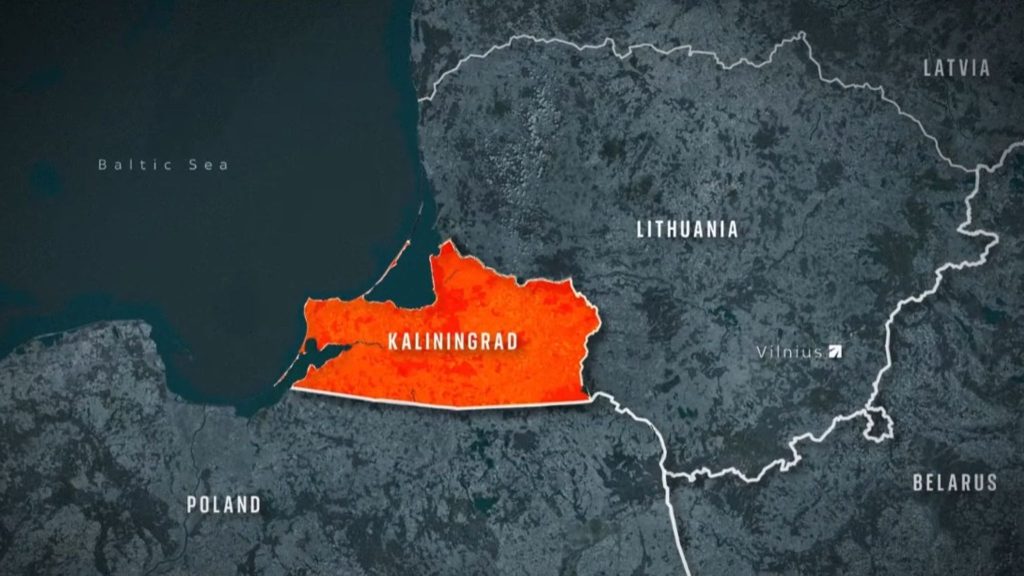
Kaliningrad Oblast
Russian Baltic exclave bordered by Poland and Lithuania, central to a wargame examining mutiny, NATO tensions and military vulnerability.
Also known as: Kaliningrad · Königsberg · Kaliningradskaya oblast
Overview
Kaliningrad Oblast is the westernmost federal subject of Russia. It is a semi-exclave on the Baltic Sea, bordered by Poland to the south and Lithuania to the north and east. Its largest city and administrative centre is Kaliningrad, known as Königsberg until 1946. The port town of Baltiysk is Russia's only Baltic Sea port that remains ice-free in winter. The oblast covers 15,125 square kilometres and had a population of roughly one million in the 2021 Russian census.
History
The territory was formerly the northern part of East Prussia and was overwhelmingly inhabited by Germans. After the defeat of Nazi Germany in World War II, the Soviet Union annexed the region into the Russian SFSR. The post-war flight and expulsion of Germans left the area largely unpopulated until it was resettled by Soviet citizens, mostly ethnic Russians.
Strategic significance
Because it is separated from the Russian mainland by NATO members Lithuania and Poland, Kaliningrad has been discussed in relation to the Kaliningrad question, a political question about its status as a Russian exclave and its isolation in the Baltic region after the 2004 enlargement of the European Union. Western media often discuss the region in relation to missile deployments, and Russia views it as a vital element of its ability to project power in the Baltic region.
Relevance to the wargame
In the news context, Kaliningrad served as the setting for a crisis simulation in which a staged mutiny erupts in the Russian exclave, with rebels taking the territory's governor hostage and plotting to move tanks and troops into neighbouring Lithuania. The exercise was presented as a way to examine Kaliningrad's vulnerability and the pressures it could create for Moscow, rather than only imagining a Russian attack on NATO's eastern flank.
Related translated reports
Wargame with a difference as Russia faces dilemma
Mutiny erupts in the Russian exclave of Kaliningrad in an uncomfortable test for the Kremlin.
Mutiny erupts in the Russian exclave of Kaliningrad in an uncomfortable test for the Kremlin. A group of rebels takes the territory's governor hostage and plots to send tanks and troops over its border into neighbouring Lithuania, which is part of the NATO alliance. The goal of the mutineers - who want Moscow to take an even harder line with the allies than it already does - appears to be to start a fight with NATO that then forces the rest of Russia to roll in behind them and triggers a wider war between Moscow and the West. It is one of three "crisis simulations" that took place at a university in Lithuania last week, with academics, former diplomats and other experts from the UK and across Europe playing the part of the Russian side, the mutineers and various NATO member states. Sky News' Defence Insider was given exclusive access to watch what unfolded during the staged mutiny. You can watch what happened by visiting the app. Click here to download our new app and get 3 months free. £14.99 a month thereafter unless cancelled. New customers only. Terms apply. The exercise was created by a new think tank, called the Baltic International Security Centre, and Lithuania's ISM University of Management and Economics. Edward Lucas, a British journalist and Russia expert, founded the think tank and helped to organise the simulations. He said they were a deliberate contrast to other scenarios that imagine Russian forces creating the dilemma for NATO by targeting the alliance's eastern flank. This time around, it is Moscow that is under the most pressure. Wargames "that involve scenarios where NATO does nothing, stands by, [as Russian forces] go rolling into the Baltic states, it's all nonsense", Mr Lucas said. "Actually, these countries [Lithuania, Latvia and Estonia] see things we don't see. "They hear things that we don't hear. They understand things we do not understand. They do things that we don't do. "And they are super vigilant and super ready, and they would fight like crazy. They've got allies here who are ready to fight from the first minute and [Vladimir] Putin actually knows that. "So I think it was important to look at it the other way round and talk not about so much the military threat from Russia, but the real point, which is Kaliningrad's vulnerability." Keep up with all the latest news from the UK and around the world by following Sky News The territory, home to almost one million Russians, is separate from the Russian mainland and shares borders with the NATO states of Lithuania and Poland. Mr Lucas said it was once highly militarised but many of the weapons and troops have been diverted to fight Russia's war in Ukraine, leaving the land much less well defended. Be the first to get Breaking News Install the Sky News app for free In a sign of potential nervousness in the real world about Kaliningrad, the Kremlin in recent weeks has warned that it would be willing to launch a nuclear attack in response to any challenge to the territory by NATO forces. Lithuania and Poland are watching what happens on the territory closely amid concerns that Russians living there could seek to cross into the two NATO countries to avoid any attempt by the Kremlin to round up more civilians to fight in Ukraine. Google users can see more from their preferred sources in search results - click here to make yours Sky News The Lithuanian government is even sending additional troops to defend its border with Kaliningrad in case that happens. Oana Lungescu, a former chief NATO spokesperson, helped to adjudicate the Kaliningrad wargames. She also played various roles as the scenarios unfolded, including the alliance's top military commander. "My biggest takeaway is the importance of time, the importance of doing things very fast and in a coordinated fashion," she said in an interview. "Things will come at you in the blink of an eye. They come from different directions. There's insufficient information, and there's complex decisions to be made, which is why it's important that, through NATO, all allies can reach a conclusion… and then act quickly and move fast into position and raise the readiness of their forces to pre-empt, to deter any aggression and to prevent any crisis from becoming worse."