Mark Carney
Canadian politician and economist who has served as the 24th prime minister of Canada and leader of the Liberal Party since 2025; previously governor of the Bank of Canada and the Bank of England.
Also known as: Mark Joseph Carney
Mark Joseph Carney (born March 16, 1965) is a Canadian politician and economist who has served as the 24th prime minister of Canada and leader of the Liberal Party since 2025. He has represented Nepean in the House of Commons since his election in April 2025.
Carney was born in Fort Smith, Northwest Territories, and raised in Edmonton, Alberta. He studied economics at Harvard University, graduating in 1987, and later earned a master's degree and doctorate in economics from the University of Oxford.
Before entering politics, Carney worked at Goldman Sachs for 13 years and later joined the Bank of Canada. He served as governor of the Bank of Canada from 2008 to 2013, overseeing monetary policy during the global financial crisis, and as governor of the Bank of England from 2013 to 2020. He also chaired the Financial Stability Board from 2011 to 2018.
Carney became leader of the Liberal Party in 2025 after Justin Trudeau announced his intention to step down. He was sworn in as prime minister on March 14, 2025, and subsequently led the Liberals into the 2025 federal election, where they won a plurality of seats and formed a minority government.
His premiership has included a strong emphasis on economic policy, trade, infrastructure and Canada's position in a changing international order. In a January 2026 speech at the World Economic Forum in Davos, Carney argued that middle powers should cooperate more closely in response to economic coercion and instability in the international system.
Related translated reports
Alberta’s overwhelming yes vote strengthens Carney’s hand against Trump and at home
Preliminary results showing a large Alberta majority for remaining in Canada give Mark Carney domestic momentum to rebuild the economy and confront U.S. pressure, writes the BBC's Lyse Doucet.
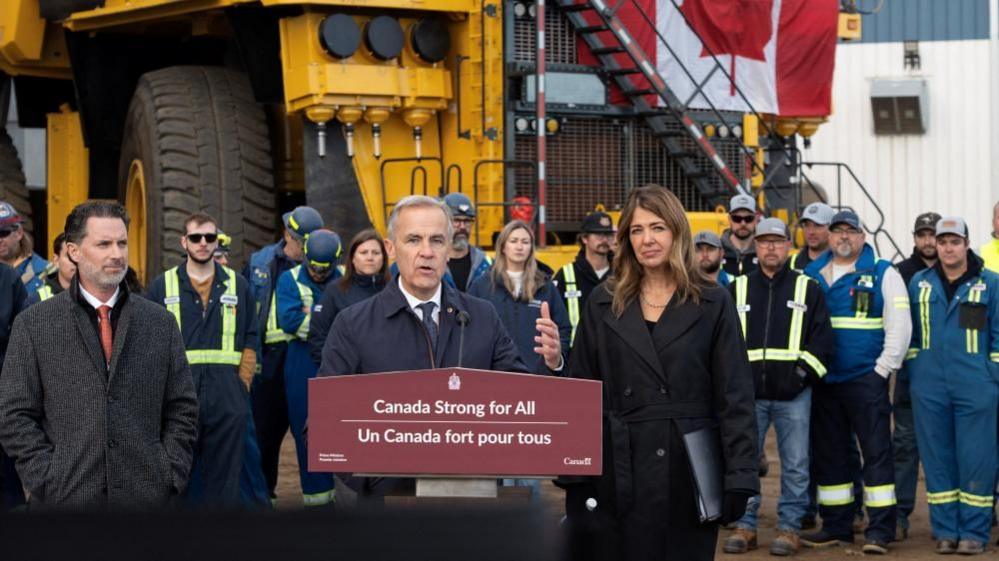
Alberta's preliminary referendum result, in which more than two-thirds of voters backed continued membership in Canada, has handed Prime Minister Mark Carney a powerful mandate at home and abroad, the BBC's Lyse Doucet writes. The outcome followed Carney's appeal to cheering crowds in Calgary last week, where he declared, "Vote like Canada depends on it," on a stage covered in bright red and white Forever Canadian banners. The message appears to have resonated, and the overwhelming yes to staying in Canada now supplies Carney with political building blocks. The vote also matters because the federation's future still rests on Alberta, the country's richest province, which holds most of Canada's proven oil reserves and abundant gas and mineral wealth. It is central to Ottawa's effort to survive a punishing trade war with the United States by diversifying trade, strengthening the economy and forging new alliances on the other side of the world. Carney, a former central banker who grew up in Alberta, has become Canada's builder-in-chief at home and beyond its borders. The emphasis was notable: once the scale of Monday's separation-vote victory was clear, his first statement stressed, "They chose unity, to build together, and to take care of each other." Thomas Lukaszuk, a former lawmaker whose Forever Canadian campaign played a key role in the referendum outcome, addressed elated supporters in Edmonton, the provincial capital, as the yes count kept tumbling in. He warned, "Don't mess with Canada," and said the vote would send a very strong message to the rest of the world. Everyone understood the reference to the troublesome neighbour to the south, especially its president, who keeps threatening to turn Canada into the 51st U.S. state. On the same day Albertans voted, Donald Trump sent his own signal north at a rally in Kansas ahead of next month's U.S. midterm polls. He promised, "I will let you keep ice hockey, and I will let you keep your 'O Canada' national anthem," before adding, "We're only kidding." For Canadians, it is no laughing matter. In the run-up to the referendum, Carney repeated a warning he has often sounded: "there are some outside our borders who are working to break us, so they own us." He did not spell out who they were, and he did not have to. During a defining time for the separatist camp, some of its most prominent leaders did not hide their direction of travel; they admitted travelling to Washington three times last year to meet U.S. State Department officials and outline what an independent Alberta could offer, including a possible oil pipeline through the United States to the Pacific. The vote was historic for Canada and sparked conversations and concerns from coast to coast to coast, though the rest of the world may take only passing notice. Professor Janice Stein, founding director of the Munk School of Global Affairs and Public Policy at the University of Toronto, said that short of a vote to separate, most foreign governments except the United States have little interest in domestic Canadian politics. She added that foreign investors are focused on the time it will take to complete major infrastructure projects, a return on investment and predictable regulations, a nod to Carney's long list of megaprojects he hopes will eventually turbocharge economic growth. They are all costly, and many will take years to build. An ambitious blueprint already includes a proposed pipeline to the Pacific coast that opens opportunities for Alberta's oil to reach Asian markets. The move also addresses Alberta's long-standing grievance that its economy has been stifled by federal policies, including environmental regulations. At a rally in Alberta last week, Carney's comment that the pipeline "will reduce our dependence on the United States" triggered the loudest and longest applause of the night. After Monday's vote, Carney, the former UN Special Envoy for Climate Action and Finance, pointed to "unleashing our full potential as a global energy superpower with Alberta as its core." Political and economic pressures now seem to eclipse his green credentials. "Build Canada Strong" has been his mantra ever since he first entered politics as a complete neophyte at the start of last year. At home, the final tallies of the referendum's nine other questions could have wide-reaching repercussions. They dealt with issues ranging from greater provincial powers and the costs of immigration to potential constitutional changes. Those results are certain to provoke debate and deal-making or deal-breaking involving Canada's nine other provinces and three territories, all of which have their own grievances. Carney has had to defend himself when journalists ask whether he is spending too much time on foreign trips with a charm offensive to build new political alliances and trade partnerships, including an unprecedented and still uncertain offer of associate membership of the European Union. He recently replied with signature bluntness, "I can do both and I need to do both," before listing more than 16 bills that went through Parliament in the last session dealing with everything from major tax changes and public safety to the price of fuel. For now, Carney is riding high in the polls at home, including in Alberta, which does not traditionally support his Liberal party, and is enjoying a long "political honeymoon" that other beleaguered politicians would envy. The plain-speaking politician's strong and steady response to Trump threats, including retaliatory tariffs, has seen his star rising on the world stage. That is an unexpected turn for a country that has often been missing from top tables and has sometimes even been dismissed as "boring". The Economist magazine decided to put Carney on its cover during this week of weeks for Canada, showing a perfect red maple leaf between his teeth. One headline read, "Mark Carney shows middle powers how to handle a dangerous world," while the article also focused on Canada's "vulnerabilities", including Alberta's ballot. David Moscrop, a political scientist and author of the forthcoming book On Nationalism, said, "The broader takeaway from this vote might be that Canadian unity is in fine shape." But he asked, "But what happens after Donald Trump is gone and Canada no longer has a single, bombastic target which drives Canadians to rally around the flag?" Carney's decision to recently walk away from trade talks with the United States gave rise to another swell of Canadian pride and patriotism. Yet if this trade war drags on with a country that traditionally takes 70% of Canada's exports, Canadians will feel even greater pain in their daily lives. Still, today is a day to vigorously wave the maple leaf flag. CBC journalist Janyce McGregor said during the public broadcaster's rolling coverage, "It's a win for Team Canada and its resilience."