Rescue and Subsequent Return of a Trapped Dusky Shark in Busan Canal
A 3-meter-long female dusky shark, nicknamed Bukang-i (named after the North Port, Bukhang), was successfully guided out of a canal in Busan after being trapped for over a month, averting immediate health risks from dropping water temperatures. However, the shark returned to the waterway and was later found swimming in a narrow space between a floating platform and a net. The waters near the pier where it was spotted are not considered open sea, and authorities hope it will eventually navigate to open waters. The shark's month-long stay turned it into a national celebrity, drawing millions of visitors and sparking a localized cultural and economic phenomenon, while its current entrapment poses renewed challenges for authorities and concerns for its survival.
Background
- Dusky sharks prefer water temperatures between 18C and 26C. Their physiological functions start to decline below 15C, and survival becomes precarious at around 11C. The Busan canal was expected to reach 11C after the middle of November, posing a severe threat to the trapped shark.GUARDIAN
- In the first half of the year, 46 large sharks were recorded off the east coast of South Korea, nearly four times as many as a year earlier. This significant increase is attributed to warmer seas and an abundance of prey in the region.GUARDIAN
Key actors
- Busan municipal officials, South Korea’s oceans ministry, the national institute of fisheries science, and Coast Guard officials: Government and scientific bodies that organized the rescue operations, monitored the shark, and deployed joint teams using pontoons and nets.GUARDIAN ABCNEWS YONHAP YONHAP
- Self-appointed guardians (jagyeongdan) and YouTubers: Grassroots volunteers who patrolled the waterfront at night to protect the shark from harmful lights and monitored the situation when official presence was disputed.GUARDIAN
- Lee Jae Myung: South Korea’s president, who visited the canal to see the shark in mid-October.GUARDIAN
- Chun Jae-soo: Busan Mayor, who publicly expressed gratitude for the public's interest and hoped for the shark's healthy life in the sea.ABCNEWS
Confirmed facts
- The shark sustained an abrasion on her snout, likely caused by being startled by a visitor's torch, and thrashed about at night due to lights, making the situation dangerous.GUARDIAN
- The shark's presence sparked a localized industry, including a commemorative soju, a baseball mascot in a shark cape, an honorary city ambassadorship, and a surge in sales for nearby shops.GUARDIAN
- After being guided out, the shark returned to the waterway and was seen swimming Thursday morning in a narrow space between the floating platform (pontoon) and a net set up as a second backstop.YONHAP
- The shark was spotted near a pier outside the canal at around 6 p.m. Wednesday, and visitors reported seeing it swim back into the canal around 11 p.m. Wednesday.YONHAP
- The waters near the pier where the shark was spotted outside the canal are not considered open sea.YONHAP
- Officials launched the third rescue attempt specifically due to concerns that the shark could die if water temperatures fell further.YONHAP
Claims and disputes
- The extent of official nighttime monitoring is disputed; officials claimed 105 personnel from seven agencies were watching over the shark with a rapid response team, while YouTubers stated it was almost entirely up to them to watch over the shark after dark.GUARDIAN
How sources covered it
- Focuses on the cultural and economic phenomenon surrounding the shark, grassroots protection efforts by YouTubers and 'jagyeongdan', the environmental context of rising shark populations due to warmer seas, and specific physiological temperature thresholds for dusky sharks.GUARDIAN
- Focuses on the logistical details of the rescue operation (floating platform, previous failed attempts using water streams and nets), expert concerns regarding the shark's health and feeding habits, and official statements from local government.ABCNEWS
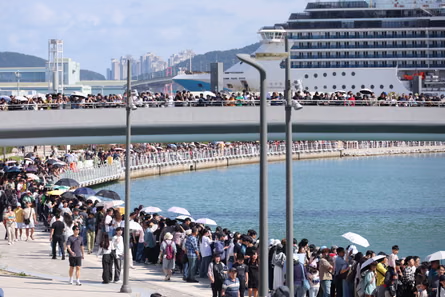
- Focuses on the visual spectacle of huge crowds watching the rescue, the logistical detail of the third attempt to guide the 3m shark back to the open sea, and the oceans ministry's announcement of the successful rescue.BBC
- Focuses on the shark's unexpected return to the canal, the physical barriers (pontoon and net) trapping it in a narrow space, the involvement of the Coast Guard, and precise hourly timelines of the shark's movements post-rescue.YONHAP
- Focuses on the naming origin of Bukang-i, the specific timeline and logistics of the third rescue operation steering the shark toward Marina Bridge, and the clarification that the pier waters are not considered open sea.YONHAP
Reactions
- Busan Mayor Chun Jae-soo expressed gratitude for the public's interest on Facebook and hoped for the shark's healthy life in the blue sea.ABCNEWS
- South Korea’s president, Lee Jae Myung, visited the canal to see the shark in mid-October.GUARDIAN
- YouTubers found the use of water pumps and nets on the shark objectionable and ended up cheering her on instead.GUARDIAN
- Self-appointed guardians (jagyeongdan) patrolled the waterfront at night to protect the shark from visitors shining torches or lasers into the water.GUARDIAN
- Observers suggest the fish could have swum its way back into the canal by passing under the floating platform (pontoon).YONHAP
- Authorities hope the shark will eventually make its way into open waters.YONHAP
Impact analysis
- Economic and Cultural Impact (Occurred): The shark's presence created a localized industry, including a commemorative soju, a baseball mascot in a shark cape, an honorary city ambassadorship, and a surge in sales for nearby shops.GUARDIAN
- Environmental Indicator (Occurred): The recording of 46 large sharks off the east coast in the first half of the year (nearly four times the previous year) indicates ecological shifts attributed to warmer seas and more prey.GUARDIAN
- Health and Survival (Expected/Addressed/New Risk): The successful rescue initially prevented the shark from facing precarious survival conditions due to dropping water temperatures. However, its return to the canal and subsequent entrapment between the pontoon and net poses renewed survival and health risks.GUARDIAN YONHAP
Open questions
- What specific long-term ecological impacts will the warming seas and increased large shark populations have on the local marine ecosystem off the east coast of South Korea?GUARDIAN
- How will authorities adjust the physical barriers (pontoon and nets) or rescue strategy to prevent the shark from remaining trapped in the narrow space or returning to the canal?YONHAP
Timeline
- The fisheries institute recorded 46 large sharks off the east coast.GUARDIAN
- First failed attempt to free the shark using boats spraying streams of water and nets.ABCNEWS
- Second failed attempt to free the shark.ABCNEWS
- South Korea’s president, Lee Jae Myung, visited the canal to see the shark.GUARDIAN
- The shark was photographed swimming in the canal at North Port.YONHAP
- Authorities began the third rescue operation, steering the shark toward Marina Bridge with a net.YONHAP
- Some visitors reported seeing the shark swimming back in the canal.YONHAP
- The shark was seen swimming in a narrow space between a flat floating platform and a net.YONHAP
- South Korea's oceans ministry announced the shark was successfully guided out of the canal.BBC
Related news
Third try the charm as shark leaves Busan canal after more than a month Click to expand the full report Collapse full report
A shark that had been stuck for more than a month in a canal at Busan's North Port left the waterway Wednesday after a joint team of city and Coast Guard personnel succeeded on their third try at herding it out. The shark, first seen there Sept. 18, was later found near a pier outside the canal, though the spot is not yet the open sea authorities hope it will reach.
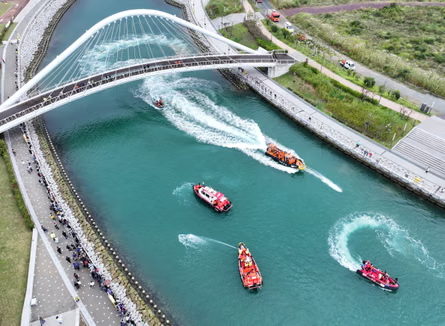
BUSAN, Oct. 21 (Yonhap) -- A shark that spent more than a month stuck in a canal at Busan's North Port left the waterway Wednesday, after a joint team of municipal and Coast Guard personnel succeeded on their third try at herding it out. The crew set its plan in motion at around 10 a.m., fixing a net to a pontoon -- a flat platform that floats -- and using it to push the animal toward Marina Bridge. By approximately 6 p.m., the shark, until then swimming close to the bridge, had turned up in waters beyond the canal, next to a pier. Its appearance there meant Bukang-i was no longer inside the canal, at least for now. Even so, the waters by the pier do not amount to open sea, and officials hope the animal will keep moving until it reaches open water. The shark's name comes from Bukhang, Korean for North Port. It was first seen in the canal on Sept. 18, and its presence quickly turned the canal park into a major draw: more than 1.6 million people had visited as of Sunday. Two earlier pushes to send the fish toward the open sea came to nothing, after which authorities stood back in case it left on its own. When it failed to do so, they moved again, fearing that a further fall in water temperatures could prove fatal. Yonhap photographs showed the shark still swimming in the canal as recently as Oct. 17, 2026. Busan, a port city in the country's southeast, sits about 330 kilometers southeast of Seoul.Night-watch guardians guide endangered shark Bukang-i out of Busan canal Click to expand the full report Collapse full report
South Korea’s oceans ministry said a stranded female dusky shark nicknamed Bukang-i was guided out of a Busan canal on Wednesday, on the third attempt after more than a month there. Ordinary volunteers, many of them YouTubers, spent nights protecting the animal and warning people against shining torches or lasers, which officials and experts linked to possible distress and injury.
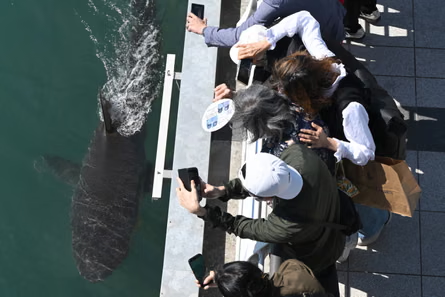
Busan’s canal became an unlikely stage for a month-long rescue effort after a female dusky shark, about 3 metres long, was found stranded there on 18 September. The animal, nicknamed Bukang-i after Bukhang, the Korean name for the city’s North Port, belongs to a species classed as endangered worldwide. The city said more than 1.6 million visitors came to see it at a park that once drew about 2,000 people on a busy Saturday, and the shark became a national celebrity. On Wednesday, after more than a month in the canal, South Korea’s oceans ministry said the shark was successfully guided out on the third attempt. Officials expect her to move into open water in time. Authorities had previously made two failed attempts to steer her back to sea, and further efforts were paused because additional force was thought likely to distress her. Until she left, the shark remained in the canal, drawing crowds by day and leaving a handful of men to keep watch after dark. A group of self-appointed night watchers, known in South Korea as jagyeongdan, a term that sits somewhere between a vigilante group and a neighbourhood watch, gathered around the harbour-side canal in Busan and took turns protecting the shark. Many were YouTubers who livestreamed the waterway and stayed through the night, wearing hi-vis vests and carrying selfie sticks, while calling out visitors who used torches or lasers. Some of their videos were viewed hundreds of thousands of times. Choi Won-jin, one of the protectors, who has run a YouTube channel for 10 years covering trending issues in South Korea, said he arrived when the canal lights went out and waited for people whom Koreans online call 'lantern villains'. 'They bring fishing lamps, or the kind of lights people use at a campsite,' he said. 'We’re ordinary members of the public. So we have no choice but to put it nicely, and get them to understand as best we can.' Na Tae-soo, a nearby YouTuber among the watchers, said most visitors complied when asked not to shine lights. 'Don’t, please don’t switch the torch on,' he said. 'The animal thrashes about at night because of the torches, and it’s dangerous.' His footage showed the shark sharply twisting away from a beam of light at 2am and hitting the side of the canal. The national institute of fisheries science later confirmed an abrasion on her snout and said a visitor’s torch was likely to have startled her into injury. The men patrolled the canal’s park after dark, checked that conditions were in order, ate snacks as the night passed and aired frustrations on livestreams. Korean media reported that 105 officials from seven agencies watched over the shark, with a team on standby to reach the water within three minutes. Choi disputed that account, saying that after dark the protection effort was almost entirely up to him and the other volunteers. The waterfront was closed to the public from midnight until 5am, but the YouTubers said the rule was impossible to enforce across a park of that size. While livestreaming from the walkway one night, Choi filmed a man tipping food waste into the water. Nobody saw the shark feed, though experts said feeding could happen in an instant and sharks of her size did not need to eat often. Experts had also hoped cooler water would encourage the shark to leave. The fisheries institute said dusky sharks prefer water between 18C and 26C, while experts put 15C as the point below which her physiological functions would begin to decline and about 11C as the point at which survival would become precarious. Busan city officials had expected the canal to reach that temperature after the middle of November. The institute recorded 46 large sharks off the east coast in the first half of this year, nearly four times as many as in the same period a year earlier, attributing the rise to warmer seas and more of the fish that sharks feed on. The public affection for Bukang-i also spawned commercial and civic responses, including a commemorative soju, a baseball mascot dressed in a shark cape, an honorary city ambassadorship, and reports of increased sales at nearby shops. South Korea’s president, Lee Jae Myung, visited the canal in mid-October. None of the shark’s guardians believed she should be forced out. Choi said the city should protect her where she was until she left of her own accord. Kim Jong-hwan, who runs a small business and livestreamed the shark almost every day while also watching by day, said he initially went to pass information to followers, then began observing her. 'I went to pass on information [to my followers], and after that I started observing her,' he said. 'Watching her over time, with the water pumps being fired and then the nets, I came to find those things being done to her objectionable. So we ended up cheering her on,' he said. 'She’s just an animal, and she came in by her own choice,' Kim said. 'If it gets cold, if there’s no food, if the water doesn’t suit her, she’ll leave by herself. I’d like her to just be left alone, to rest there comfortably until then, and go.'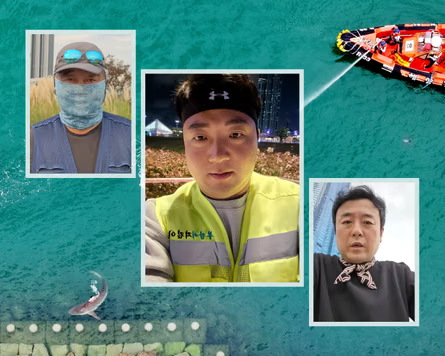
Shark freed from Busan canal after more than a month trapped in confined waters Click to expand the full report Collapse full report
South Korean officials have successfully guided a large female dusky shark out of a canal in the port city of Busan after it spent more than a month there and drew over 1.7 million visitors.
After two unsuccessful rescue operations, South Korean officials on Wednesday managed to guide a shark that had been confined to a canal in the port city of Busan for more than a month back toward the sea. The female dusky shark, measuring 3 meters (9.8 feet) in length, was nicknamed Bukangi, a name derived from the Korean term for Busan’s North Port. According to Busan Mayor Chun Jae-soo, officials spent hours maneuvering a floating platform to steer the animal along the narrow waterway. Although the shark initially remained near the canal entrance, it eventually swam out to sea. Bukangi was first observed in mid-September. As it repeatedly circled the canal, with its fins visible above the water, the shark became an attraction for visitors. City officials adopted it as a mascot and said more than 1.7 million people had come to see it. Despite weeks of effort, however, authorities struggled to find an effective way to return the animal to open water. The successful operation on Wednesday was the third attempt. Earlier efforts on Sept. 29 and Oct. 2 failed when boats sprayed water at the shark and nets were positioned across the narrow canal. The animal evaded the boats and passed over the nets. The prolonged confinement also raised concerns among experts about the shark’s health. They reported that it had shown no signs of eating throughout its monthlong stay and warned that declining water temperatures could create further health risks. For the latest attempt, workers carefully moved a large floating platform through the canal to push the shark toward the exit. Those aboard used oars to redirect Bukangi whenever it approached the structure, while dozens of workers along both banks pulled ropes to move the platform forward. Hundreds of spectators gathered along the canal to watch the unusual rescue. The team advanced the platform approximately 1 kilometer (0.6 miles) toward the canal mouth. Additional nets were installed ahead of the structure to keep the shark from returning to the waterway. Officials had not immediately established how far Bukangi traveled into the open sea. South Korea’s Yonhap news agency reported that the shark was spotted near a nearby pier. In a Facebook post, Chun thanked people for their interest in the animal and the city’s waters. “We will never forget the great interest people have shown for Bukangi and Busan’s waters,” he wrote. “We hope Bukangi can live a healthy life in the blue sea.”Shark Freed from Busan Canal After Massive Public Spectacle Click to expand the full report Collapse full report
South Korea's Ministry of Oceans and Fisheries announced early Thursday that the shark trapped in a Busan canal had been successfully guided out, concluding a multi-day rescue operation that drew huge crowds to the waterfront park.
Authorities confirmed in the early hours of Thursday local time that the shark, which had been confined within a narrow waterway in Busan for over a month, was safely escorted out of the canal. The announcement marked the end of an intense and highly publicized rescue effort that transformed the site into a major tourist attraction. The creature, locally nicknamed 'Bukang-i' after the nearby North Port, first appeared in the canal on September 18. Its presence sparked significant public interest, with officials estimating that more than 1.6 million visitors flocked to the area by Sunday to catch a glimpse of the marine animal. The sheer volume of spectators turned the routine wildlife incident into a national spectacle. Rescue teams from the city government and the Coast Guard executed a coordinated plan to steer the shark toward the exit using nets attached to floating pontoons. This methodical approach followed two previous unsuccessful attempts to guide the animal back to open waters. Officials had grown concerned that dropping water temperatures could endanger the shark's survival if it remained trapped, prompting the decisive action taken earlier this week. While the shark has now left the confines of the canal, authorities noted that it must still navigate from the pier-side waters into the open sea. Monitoring continues to ensure the animal makes its way safely away from the urban waterway.Shark herded out of Busan canal finds its way back in less than a day Click to expand the full report Collapse full report
BUSAN, Oct. 22 (Yonhap) -- A shark that spent more than a month in a canal in the southeastern South Korean city of Busan and was finally steered out has been spotted back in the waterway, apparently having slipped beneath a floating barrier installed to keep it out.
BUSAN, Oct. 22 (Yonhap) -- The shark that had lingered for more than a month in a canal in the southeastern South Korean city of Busan is back in the waterway, less than a day after a team of officials finally managed to steer it out. Some visitors reported seeing the fish swimming in the canal again at around 11 p.m. Wednesday, only hours after it had been located in waters near a pier outside the canal. By Thursday morning, it was seen moving through a tight gap between a pontoon -- a flat floating platform placed near the exit to block its return -- and a net rigged behind the platform as a second line of defense. Observers say the animal may have slipped back in by swimming beneath the pontoon. The removal operation, carried out Wednesday by a joint team of municipal and Coast Guard personnel, used a net attached to a pontoon to guide the shark toward the canal's exit. At around 6 p.m., the fish was spotted in waters by a pier outside the canal, though those waters are not regarded as open sea. Two earlier efforts to usher the shark toward the open sea had failed, after which officials had waited for it to leave the canal on its own. When it failed to do so, they proceeded with the third attempt over concern that a further drop in water temperatures could kill the fish. Dubbed Bukang-i after Bukhang, the Korean name for North Port, the shark was first seen in the canal on Sept. 18. Its long stay has turned the canal park, which lies about 330 kilometers southeast of Seoul, into a major draw, with more than 1.6 million people visiting as of Sunday. [Photo caption: Authorities carry out a third operation to steer a shark out of a canal in a waterfront park in the port city of Busan, some 330 kilometers southeast of Seoul, on Oct. 21, 2026. (Yonhap)] yusbvtyhtoo@yna.co.kr (END)