Nord Stream pipeline sabotage
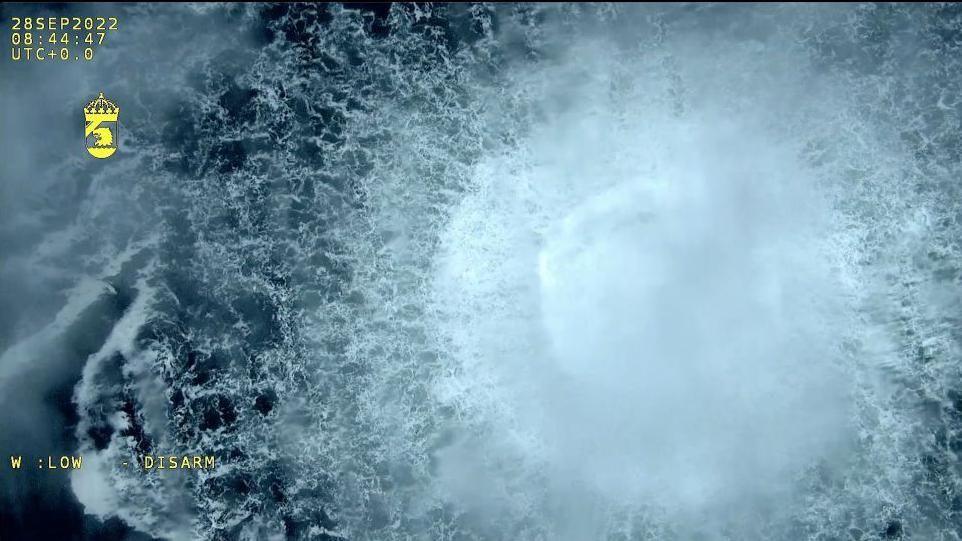
The September 26, 2022 underwater explosions that severely damaged three of the four offshore natural gas pipelines running from Russia to Germany beneath the Baltic Sea.
Also known as: Nord Stream sabotage
Overview
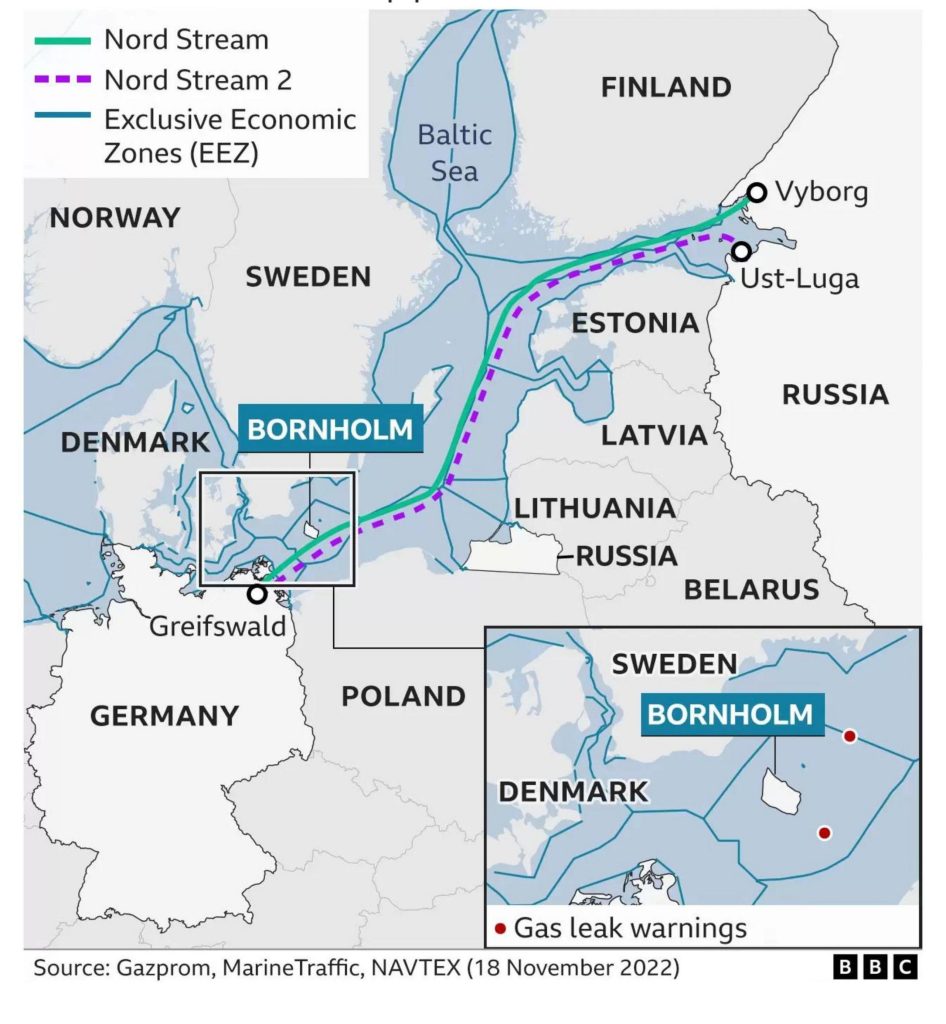
The Nord Stream pipeline sabotage refers to the series of underwater explosions on September 26, 2022, that ruptured and rendered inoperable three of the four offshore natural gas pipes comprising the Nord Stream 1 and Nord Stream 2 networks. The infrastructure, running beneath the Baltic Sea from Russia to Lubmin, Germany, was majority owned by the Russian state-controlled company Gazprom. At the time of the attacks, gas deliveries through Nord Stream 1 had been indefinitely halted by Russia, and Nord Stream 2 had never entered commercial service following Germany's suspension of its certification prior to the Russian invasion of Ukraine.
Incidents and Investigations
The explosions occurred in international waters within the exclusive economic zones of Denmark and Sweden, causing massive natural gas leaks. Initial international investigations were launched by Denmark, Sweden, and Germany. While Danish and Swedish inquiries were eventually closed, German federal prosecutors pursued a criminal investigation centered on a team of deep-sea divers who allegedly used a rented yacht named the Andromeda.
Legal Proceedings
German authorities issued European arrest warrants for Ukrainian suspects allegedly involved in the plot. Serhii Kuznetsov became the first suspect to stand trial in Hamburg, facing charges under Germany's code of crimes against international law for an attack on civilian infrastructure. The case has involved complex extradition battles across Europe, differing international judicial rulings, and heightened geopolitical sensitivity regarding European energy security and relations between Germany and Ukraine.
Related translated reports
First Nord Stream suspect stands trial in Hamburg four years after Baltic Sea pipeline blasts
Serhii Kuznetsov, a 50-year-old Ukrainian accused of ordering divers to destroy the Russia-to-Germany gas pipelines in 2022, has appeared in a German court charged with a war crime, while his lawyers argue the case rests on nothing but circumstantial evidence.
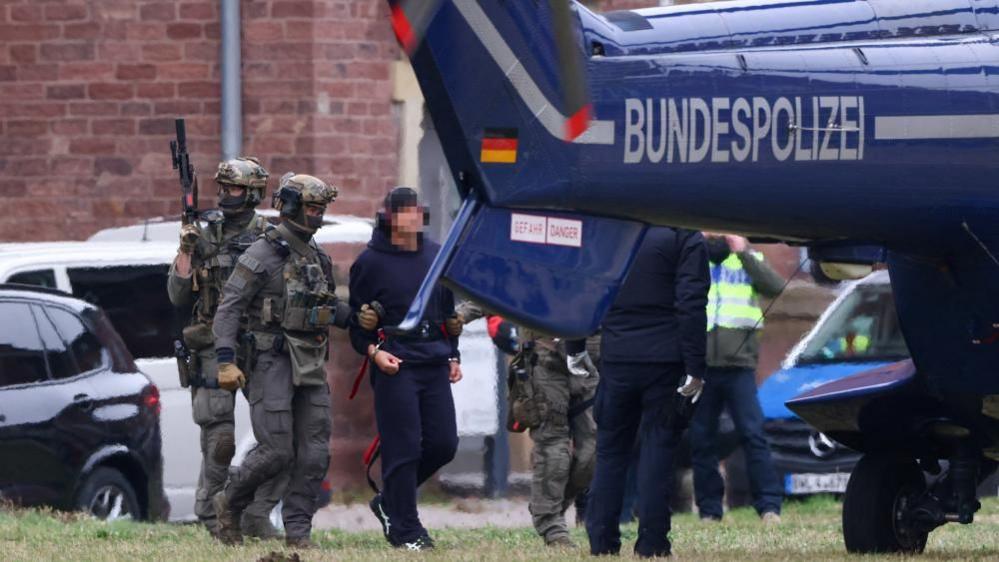
Almost exactly four years after explosions tore through three of the four Nord Stream gas lines beneath the Baltic Sea, the first defendant charged over the attack appeared before a court in Hamburg on Wednesday morning. Serhii Kuznetsov, 50, walked into the courtroom looking at ease in front of a full public gallery, smiling at points as he confirmed basic biographical details, among them his name and where he was born. Until Wednesday, when judges lifted an order protecting his identity, German prosecutors had referred to him only as Serhii K and released images in which his face was obscured. Wearing headphones, he appeared to follow a Ukrainian interpretation of the hearing closely as the charges were read out. He stands accused of a leading part in the operation that wrecked the pipelines off the island of Bornholm on 26 September 2022. Prosecutors say he ordered divers and an explosives specialist to strike civilian infrastructure, and they have brought the charge as a war crime under Germany's code of crimes against international law, characterising it as an "attack by military means against civilian objects". His lawyers want the proceedings dismissed altogether. They told the court that four years of investigation have produced nothing beyond circumstantial evidence, and argued that their client, as a soldier, was bound by an obligation of secrecy and therefore could not receive a fair trial in which he could speak freely. One member of the defence team also challenged the legality of his transfer to Germany, saying the war crime allegation was never mentioned during the extradition process. Kuznetsov, who was extradited last year, denies the charges. So does a second suspect, who is resisting being sent from Croatia. The prosecution maintains that in 2022 Kuznetsov was a serving officer in the Ukrainian army who led a group of professional divers together with a boat captain and an explosives expert. The case is acutely awkward for Germany, which has ranked among Ukraine's staunchest backers since Russia launched its full-scale invasion in February 2022 — seven months before the pipelines were hit. When the blasts happened, suspicion in Western capitals drifted toward Moscow, although no government directly assigned blame. Nord Stream 1 had already stopped carrying Russian gas to Germany weeks earlier, and Nord Stream 2 had never been switched on; Berlin had suspended the multi-billion dollar project shortly before the invasion, and there had been accounts of unusual Russian naval movements ahead of the explosions. Russia's Vladimir Putin pointed the finger instead at the United States and its British partners, blaming "the Anglo-Saxons" — an accusation both countries rejected. Investigators from Sweden, Denmark and Germany tried to establish who was behind the attack. After Denmark and Sweden closed their inquiries, German prosecutors concentrated on a team of deep-sea divers who had rented a yacht named the Andromeda from the northern German port of Rostock. They later stated that "traces of subsea explosives were found in the samples taken from the boat". Despite the diplomatic strain with Kyiv, prosecutors pushed the case forward, and in January 2025 Germany's federal court of justice ruled that the attack fell within German territorial jurisdiction and that prosecutors were obliged to act because it involved "undermining [Germany's] internal security". The indictment goes further, alleging that the saboteurs conceived the plot "acting by order of Ukrainian state agencies" — a claim Ukraine's Volodymyr Zelensky has always rejected, maintaining that his country had "nothing to do with [the Nord Stream blasts]". Opinion in the two capitals diverges. Oleksandr Merezhko, who chairs the Foreign Affairs Committee in the Ukrainian parliament, observes that the pipelines were blown up while his country was at war with Russia, and that "Nord Stream 2 was nothing but a tool used by Russia in order to get prepared for the war". He told the BBC there had been no confirmation of the German account: "It's one of the versions." In Berlin, Stefan Meister of the German Council on Foreign Relations said successive chancellors had sought to strip the case of its political charge. "They tried to make not a big story out of it, not to give it too much attention, to give it to the institutions, to the judiciary that they will deal with it. This is not a political case. So they tried to depoliticise it," he explained. Kuznetsov's road to the dock began in August 2025, when he was arrested after checking into a hotel near the Italian Adriatic resort of Rimini by police executing a European arrest warrant issued by federal prosecutors in Germany. He fought extradition for several weeks through the courts, during which his surname surfaced in court documents, and was transferred to Germany late last year. His treatment contrasts sharply with that of another Ukrainian, Volodymyr Zhuravlov, who successfully fought off Germany's extradition bid in Poland. In October 2025 a Polish judge ordered his release, ruling that the attack on the pipelines was not unlawful and that if Ukraine had organised an armed mission it was "justified, rational and just" — a conclusion at odds with that of Italy's Supreme Court. That freedom did not hold: last August he was detained in Croatia on suspicion of being a suspect who "participated in the dives necessary" for the sabotage. Last month Croatian authorities approved his extradition, though it remains unclear when that will take place and whether his case could ultimately be folded into the Hamburg trial. For all the discomfort the prosecution creates between Berlin and Kyiv, Merezhko does not believe it will damage the relationship, saying "it's in the best national interests of Germany to continue to support us".