2026 Panama earthquakes
A pair of magnitude 7.7 and 6.6 earthquakes that struck Panama on October 9, 2026, causing widespread damage, injuries, and a national state of emergency.
Also known as: 2026 Panama earthquake
Overview
On October 9, 2026, a powerful magnitude 7.7 earthquake struck the Azuero Peninsula in Panama, followed by a magnitude 6.6 event and more than 100 aftershocks. The disaster prompted the government of Panama to declare a national state of emergency as shaking affected communities across all 10 provinces and two Indigenous territories.
Impact and Damage
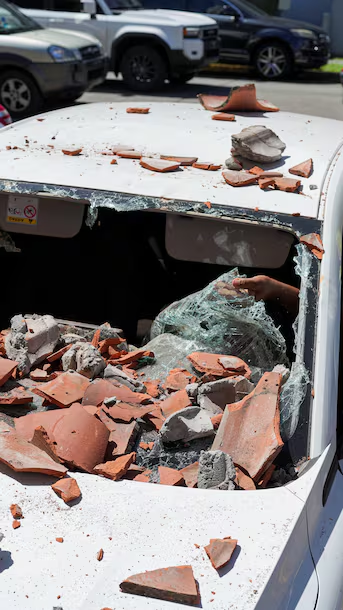
The earthquakes caused widespread infrastructure damage, affecting homes, schools, health-care facilities, roads, hotels, churches, and bridges. Damage was heavily concentrated in central provinces such as Veraguas, Herrera, Cocle, and Los Santos. Historical structures, including the Church of San Atanasio in La Villa de Los Santos, suffered collapses. While no deaths were initially attributed by officials to the immediate tremors, authorities reported at least 27 injuries and subsequent reports noted casualties. Landslides and road damage left some communities cut off, and roughly 300 residents were evacuated from Isla Cana due to rising sea levels and rough surf.
Response and Infrastructure
The national government declared an emergency during a news conference in Panama City, while the U.S. Department of State and U.S. Southern Command mobilized disaster response teams, humanitarian assistance, and food supplies. Major transportation hubs like Tocumen International Airport temporarily suspended operations before reopening, though travel disruptions affected regional connections. Operations along the Panama Canal continued normally following technical inspections.
Related translated reports
Twin quakes leave trail of damage across Panama as government declares nationwide emergency
Panama's government announced a nationwide state of emergency on Saturday after two strong earthquakes and hours of aftershocks left damage across all 10 provinces and two Indigenous territories. Officials attributed no deaths to the disaster but counted 27 people injured.
Panama spent Saturday under a state of emergency as aftershocks from a pair of powerful earthquakes continued to unsettle towns shaken a day earlier. Authorities said no deaths had been attributed to the disaster, yet damage was recorded in every one of the country's 10 provinces as well as in two Indigenous territories. The trouble began Friday, when earthquakes of magnitude 7.7 and 6.6 brought buildings down near the epicentre and set off evacuations around the Central American nation. Seismologists have since logged upwards of 100 aftershocks, among them tremors of magnitude 5.8, 5.5 and 5.2, and the initial quake also triggered tsunami warnings. The U.S. Geological Survey placed the first event about 10 kilometres southwest of Pitaloza Arriba, a remote community in the central province of Herrera, at a depth of 10 kilometres. The shaking was felt across the border in neighbouring Colombia as well. At a news conference in the capital, Panama City, Presidential Minister Juan Carlos Orillac announced the emergency measure and listed homes, schools, health-care facilities, roads and hotels among the structures harmed. Malitzie Rivera, deputy director of the National Civil Protection System, told reporters that 27 people had been hurt, with injuries ranging from minor to moderate. The central provinces of Veraguas, Herrera, Cocle and Los Santos absorbed most of the destruction. According to the civil protection agency, roughly 420 homes and about as many public schools were damaged, while seven hotels, at least 13 churches and nine bridges were also affected. In La Villa de Los Santos, a colonial-era settlement lying about 64 kilometres northeast of the epicentre, houses and a historic Catholic church fell. Residents who had spent the night outdoors waited for officials to tell them what to do next. "We've been here since 1 p.m. yesterday; we haven't moved," said Tony Jimenez, whose home partly caved in, as he sat beneath a tent with relatives. "It was a terrible thing. I can tell you with absolute certainty that in my 90 years, I had never experienced anything like it. It was intense — truly intense." The church that collapsed, San Atanasio, had been declared a National Historic Heritage Site in 1938. A Canadian in Panama was shown feeling an aftershock during a live broadcast on Hanomansing Live, and an Associated Press photograph taken by Aris Mariota on Friday captured a vehicle crushed beneath a fallen building in Penonome. Scenes of crumbling structures and deep cracks splitting roads added to unease across Latin America, a region recently battered by deadly quakes. In June, two back-to-back earthquakes of magnitude 7.2 and 7.5 struck Venezuela's La Guaira state, killing more than 6,500 people and leaving 17,000 homeless. A 7.4 magnitude quake then hit Colombia in August, claiming at least 289 lives. Carlos Valdes, head of the Seismology Department at the National Autonomous University of Mexico, suggested the comparatively low toll in Panama might stem from the country's strict building codes, notably those covering skyscraper construction in the capital. No missing people were reported as of Saturday, although officials cautioned that landslides and damaged roads had cut some communities off. Rising sea levels and rough surf forced the evacuation of roughly 300 people from Isla Cana, off the Pacific coast of Los Santos. In Penonome, some 150 kilometres from the capital, a shelter was accommodating 13 people, five of them children. The city's cathedral, facing the district's main square, suffered a partial collapse and cracking, and the governor's office building along with the Dos Continentes hotel also sustained damage. In Panama City, one of the water treatment plants serving the area was running at just 20 per cent capacity on Saturday, and six hospitals set up tent facilities furnished with cots. Tocumen International Airport, among the busiest in the region with more than 20 million passengers in 2025, temporarily halted operations after the first quake before reopening hours later on Friday. Hundreds of travellers flying with major Panama-based carriers such as Copa Airlines were nonetheless left stranded at airports around the region, their connections through Tocumen — also one of the area's biggest travel hubs — cancelled or delayed. At Mexico City's airport on Saturday, airline staff rushed to help families with babies sleeping on the floor, and one Venezuelan woman shouted in panic that flying through Panama was one of the few ways she could reach home in Caracas. Along the global trade route of the Panama Canal, the canal authority reported operations continuing normally, saying the safety of employees, vessels and crews was its priority and that specialized technical teams were inspecting facilities for possible damage. The last earthquake to cause widespread destruction in Panama struck in 1991, when a magnitude 7.4 event centred in nearby Costa Rica killed 23 people, injured 559 and left thousands homeless in the border region of Bocas del Toro. Quakes are frequent in Panama, particularly along its border with Costa Rica and its Pacific coast, where several tectonic plates — including the Cocos, Nazca and Caribbean plates — interact. The country also sits along the "Ring of Fire," a 40,000-kilometre arc of volcanoes and fault lines encircling the Pacific Basin where most of the world's earthquakes occur. Messages of support and offers of assistance poured in from around the region almost immediately. Mulino on Friday thanked fellow Latin American leaders, saying he had spoken with the presidents of Chile, Uruguay and Guatemala, among others. The U.S. Department of State said Saturday it had mobilized a disaster response team to assist local authorities with search and rescue expertise along with aerial and on-the-ground assessments. The U.S. government additionally pledged $5 million US for humanitarian assistance. U.S. Southern Command added that two helicopters, supported by the State Department's drug-control bureau, had delivered 2,000 pounds of food to Panamanian communities affected by the earthquakes.