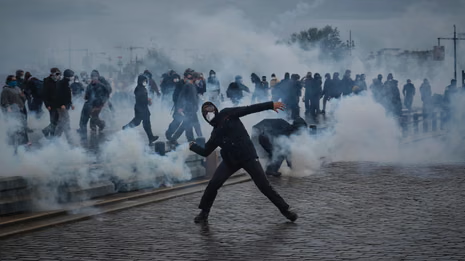
2026 France protests over public services and cost of living
A wave of mass demonstrations in France beginning in late 2026, driven by underfunded public schools, infrastructure issues, and broader cost-of-living pressures.
Also known as: 2026 French student protests · 2026 French nationwide protests
Overview
Beginning in September 2026 and expanding into nationwide mobilizations by early October, large-scale demonstrations and high school blockades took place across France. The movement involved students, teachers, parents, political organizations, and trade unions, drawing nationwide participation estimated between 550,000 and 800,000 people.
Causes and Grievances
The protests emerged from a combination of deteriorating public services and severe cost-of-living pressures. Key grievances included:
- Teacher shortages, overcrowded classrooms, and run-down, dilapidated school infrastructure.
- High temperatures in classrooms reaching up to 40 °C (104 °F) during 2026 European heatwaves.
- Stress linked to the Parcoursup university application platform.
- Soaring living costs, including high inflation, rents, unemployment, and a 36% increase in fuel prices.
Broader Context
The demonstrations in France formed part of a wider wave of 2026 European unrest affecting countries such as Italy, Spain, Portugal, Germany, Greece, and Belgium. Economists and analysts noted that the protests highlighted broader fiscal tensions in France, where high public debt—approaching 120% of the economy according to IMF data—and public spending accounting for 58% of the economy have clashed with growing demands for government support and public services.
Related translated reports
France’s fiscal turmoil offers Australia a cautionary lesson on debt, spending and living costs
Economists say France’s combination of heavy public spending, rising debt, weak growth and cost-of-living pressures should serve as a warning for Australia, where government debt and spending remain lower but have increased substantially over the past two decades.
Economists say the unrest gripping France should prompt Australia to confront difficult questions about public spending, debt and what governments can realistically afford to provide. Hundreds of thousands of people marched across French cities on Saturday over concerns including underfunded schools, teacher shortages, deteriorating infrastructure and broader cost-of-living pressures. Similar affordability strains are being felt across developed economies as households contend with persistently high prices. Luke Hartigan, a senior economics lecturer at the University of Sydney, said France’s discontent could not be attributed to a single cause, although sharply higher energy costs were playing an important role. Fuel prices in France have risen 36% this year, about three times the increase recorded in Australia, while the US-Israel war on Iran has driven European gas prices higher as the northern hemisphere heads towards winter. Hartigan said deeper fiscal pressures were also central to France’s difficulties. The country combines a large welfare state and universal social security benefits with high public debt and a stagnant economy, leaving the government facing demands for stronger services and cost-of-living support while its financial room for manoeuvre narrows. France has not recorded a balanced budget since 1974, and total public debt has climbed to almost 120% of GDP, according to the International Monetary Fund. Australia remains in a considerably stronger position, with total government debt at about 53% of GDP. However, that ratio has risen from around 40% a decade ago and from just under 10% two decades ago. Hartigan said France’s weak economic performance showed why Australia needed to improve productivity as it managed longer-term fiscal pressures. He said France’s current trajectory provided an indication of where Australia could eventually end up if present trends continued, describing it as a “warning signal”. Bob Breunig, director of the ANU’s Tax and Transfer Policy Institute, said governments in many countries were facing a widening divide between what voters expected them to deliver and what public finances could sustain. He said the belief that governments should be able to solve a broad range of personal and economic problems had become especially strong in Europe, although similar expectations were also evident in Australia. IMF figures show French public spending now accounts for 58% of the economy. In Australia, total public expenditure is equivalent to about 40% of national output, the highest level in records dating to 1990 outside the pandemic period and broadly comparable with spending levels in the United States and United Kingdom. Breunig said French protesters were calling for additional government assistance at a time when the state’s borrowing capacity was becoming severely constrained. He described French debt as approaching levels that were difficult to manage, while noting that Australia’s federal government still retained greater flexibility to borrow. President Emmanuel Macron’s decade in power has included unsuccessful efforts to restrain spending, and Breunig said there was now a sense in France that policymakers were running out of workable options. Financial markets have also become more concerned about France’s fiscal position. France generally pays a higher interest rate than Germany on 10-year government debt, and the difference between those borrowing costs is often used as an indicator of investor confidence. That spread has reached its widest level since the European debt crisis in 2011. Australia faces its own structural budget pressures, including an ageing population, the NDIS, higher interest costs and demands for increased defence spending. Breunig said the French experience showed the importance of addressing such pressures before they become entrenched. He called for an “honest public conversation” about which responsibilities governments should be expected to take on, what those commitments would cost and whether voters were prepared to fund them. Although the opposition has criticised high government spending for weakening economic dynamism, Breunig said he was broadly agnostic about whether budget repair should come through spending reductions or higher taxation. He said choosing between those options was ultimately a democratic decision.