Beau Lamarre-Condon murder trial
The New South Wales Supreme Court trial of former police officer Beau Lamarre-Condon, who is accused of murdering Jesse Baird and Luke Davies in February 2024.
Also known as: Beau Lamarre-Condon trial
OverviewThe Beau Lamarre-Condon murder trial is a legal proceeding in the New South Wales Supreme Court involving former police officer Beau Lamarre-Condon, who is accused of murdering television presenter Jesse Baird and his partner, Luke Davies, on 19 February 2024. Lamarre-Condon has pleaded not guilty to two counts of murder and one charge of aggravated break and enter.Prosecution and Defence ArgumentsThe prosecution alleges that Lamarre-Condon used his police service weapon to shoot Baird and Davies at Baird's Paddington home before attempting to dispose of their bodies at a rural property in Bungonia. The defence does not dispute that the former officer attempted to clean up the scene or dispose of the bodies, but argues that he acted in self-defence during separate struggles and panicked considerably afterward.Court EvidenceThe trial has featured extensive forensic testimony and digital reconstructions of the crime scene. Ballistics experts testified regarding bullet trajectories and stippling patterns found on a bedroom door inside Baird's home. Additionally, court proceedings examined Lamarre-Condon's prior visits to the Bungonia farm where the bodies were transported before being discovered near a monastery fence line.
Related translated reports
Firearms expert details door test as Lamarre-Condon trial hears of farm stay months before alleged killings
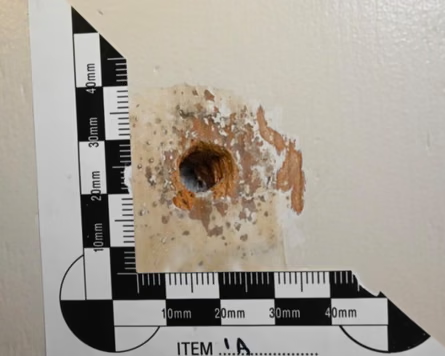
A New South Wales Supreme Court jury has watched a 3D reconstruction of the Paddington terrace where Jesse Baird and Luke Davies were allegedly shot, and heard a police firearms examiner explain how stippling around a bullet hole – which prosecutors allege was concealed with putty and a plastic hook – and a matching test-fire led him to place the muzzle 10 to 20cm from Luke Davies when the shot went off. The accused, Beau Lamarre-Condon, 31, has pleaded not guilty to two counts of murder and one count of aggravated break and enter. The defence does not dispute that he later tried to clean the scene and dispose of the bodies, saying he "panicked considerably" after acting in self-defence, but argues the men were shot accidentally in two separate struggles. The jury also heard he had stayed at a Bungonia hobby farm months before the deaths – the property where prosecutors allege he made an unsuccessful attempt to sink the bodies in a dam before they were found about 20km away at a monastery's fence line.
A computer-generated reconstruction of a Paddington terrace and a run of ballistics tests took centre stage in Sydney on Wednesday as the jury in the murder trial of Beau Lamarre-Condon weighed the prosecution's account of how Jesse Baird and Luke Davies died. Alongside the forensic evidence, the court heard that the accused officer had spent a night at a rural property months before the killings – the same place where, prosecutors allege, he later made an unsuccessful attempt to sink the two men's bodies in a dam. Lamarre-Condon, 31, has pleaded not guilty to two counts of murder and one count of aggravated break and enter over the deaths of Baird and Davies, who the crown says were shot with his police service weapon inside Baird's Paddington home on 19 February 2024. Prosecutors allege Baird was shot twice in the kitchen before a shot was fired through the bedroom door at Davies. The defence, by contrast, maintains the couple were shot accidentally during two separate struggles. Earlier in the day, jurors were shown a computer-generated video laying out the crown's version of events: a three-dimensional recreation of the terrace as it stood on the morning of the shootings, tracing the route Lamarre-Condon is alleged to have followed through the house. The model displayed photographs of bullet holes and marks, with the potential trajectories of the bullets also highlighted. Before the animation ran, Justice Natalie Adams told the jury the crown's case was that Baird was shot at close range, while the defence argues the shot came from further away. She cautioned, however, that the kitchen was not depicted to scale and that not all of the evidence bearing on the angle or distance of the shot to Baird's head had yet been put before the court. Giving evidence for the prosecution, New South Wales police firearms examiner Lucas Van Der Walt said he had greater confidence in the trajectory of the bullet that passed through the bedroom door, because it travelled through wood 35mm thick. He told the court that "stippling" was present on the door around a bullet hole which prosecutors allege was subsequently hidden with putty and a plastic hook. Stippling, he explained, is the pattern left by gunshot propellant particles, and the closer a target sits to the barrel, the tighter the spread becomes. "[It] is going to pepper itself into that softer surface – in this case a painted door," Van Der Walt told the jury. Jurors also watched a video in which the door was removed from Baird's bedroom and struck by rounds fired with the same gun and ammunition allegedly used by Lamarre-Condon. Photographs of the original hole and the test hole were then compared, with the examiner observing a "very similar spread pattern of the propellant particles impacting with the paint and the wood in the door". On that basis, he placed the firearm's muzzle somewhere between 10 and 20cm from Davies when it went off. On the side of the door through which the bullet would have exited, Van Der Walt noted that the splintering around the original hole looked more opaque than in his test. That difference, he said, was explained by the wood putty used to fill it. Defence counsel John Stratton SC put to the witness that the hole could have been made if a body had been in front of the door, but Van Der Walt replied that the "clear stippling" ruled out that scenario. Asked why no other bullet marks or rounds had been recovered from the room, he said the bullet might hypothetically have struck a pillow, a jacket or a similar item. "If that bullet continued and penetrated any of these surfaces and that object was removed and discarded, we'll never find that bullet," he told the court. Bullets fired in that way drop to the ground, he added, and since the scene was later cleaned so thoroughly, whoever tidied it could have collected a casing. The jury also heard fresh detail about the accused's ties to a property that would later feature in the crown case. In a statement read aloud by the prosecution, Michael Cella – who was 20 years old when he spoke to police in 2024 – described matching with Lamarre-Condon on the dating app Hinge in March 2023 and subsequently seeing him. Their outings took in trips to Bondi Junction to watch Hunger Games and the Taylor Swift movie in late 2023, along with shared sushi meals. In November 2023, Lamarre-Condon invited Cella away for a weekend at a cabin, but with the trip beyond his budget, Cella instead offered a stay at his family's hobby farm at Bungonia. The court heard the property had four dams and animals on the land, with fencing and a front gate held shut by chains and a padlock. The pair spent 6 November touring the district by car, viewing the animals and staying the night, and Lamarre-Condon filmed the farm before posting the footage to his Instagram story set to the Taylor Swift song You Belong With Me. Cella said he later learned of Baird after seeing Instagram posts showing him alongside Lamarre-Condon. "Beau told me they were friends. I sensed there was something more and Beau was not telling me everything," he said in the 2024 statement read to the jury. Contact between the two men tailed off from about mid-November 2023 and Cella soon lost interest; when further messages arrived from Lamarre-Condon in January 2024, he let them go unanswered, blocked the number and wiped the text exchange. Days later, the court heard, Cella received a call from a number with no caller ID, which he did not answer, followed by a message on the encrypted messaging app Signal from a contact using the name Bob. He did not respond to either. It is the prosecution's case that after Baird and Davies were killed, Lamarre-Condon attempted, without success, to sink their bodies at the bottom of a dam at the Cella family's farm. The men were later found at the fence line of a monastery about 20km from the property. The defence has not disputed that the officer tried to clean the scene and dispose of the bodies, contending that he "panicked considerably" after acting in self-defence. What remains contested is what happened inside Baird's home, where the defence says the two men were shot accidentally in the course of two separate struggles. The trial, before Justice Adams, continues.