British Medical Association
A UK trade union and professional body representing doctors and serving as a national contract negotiator with NHS employers.
Also known as: BMA
The British Medical Association (BMA) is a registered trade union and professional body for doctors in the United Kingdom. It represents doctors' professional and employment interests and is recognised by National Health Service employers as one of the national organisations that negotiates doctors' contracts.
The BMA does not regulate or certify doctors; that responsibility belongs to the General Medical Council. The association operates through a range of representative and scientific committees.
The BMA states that its aim is to promote medical and allied sciences and to protect the honour and interests of the medical profession. It also owns BMJ Publishing Group Ltd, the publisher of The BMJ, although the journal has editorial independence from the association.
Role in NHS industrial relations
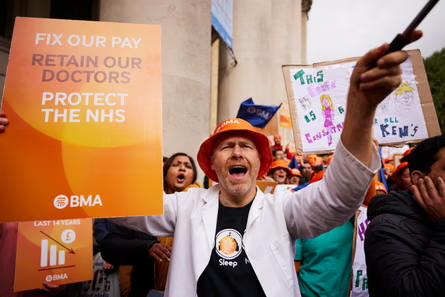
The BMA represents groups of NHS doctors in negotiations over matters such as pay and working conditions. In the dispute involving consultant doctors in England described in the news report, the BMA announced industrial action after prolonged talks with the government failed to produce agreement on pay, workload and working hours.
Related translated reports
Senior NHS consultants in England announce two-day November strike
Consultant doctors in England will walk out on 25 and 26 November after talks with the government failed to resolve disputes over pay and working hours, the BMA says. Hospitals are expected to provide emergency-level consultant cover only, while NHS leaders warn that planned care will be disrupted.
Senior hospital consultants in England are set to strike for two days in November after the British Medical Association said prolonged negotiations with the government had failed to produce agreement on pay and workload concerns. The walkout will take place on 25 and 26 November. During the action, consultants are expected to provide emergency cover only, similar to staffing arrangements on Christmas Day, while most routine consultant work is withdrawn. The doctors currently earn an average of £152,000 a year. According to the BMA, one of the central issues in the dispute is what it says has been a 25% reduction in the real-terms value of consultants’ pay since 2009-10. The union is also seeking a 10% reduction in working hours. Under that proposal, a consultant working 40 hours a week would instead work 36 hours. The BMA said consultants had spent 18 months in discussions with the government but had not secured progress on their main demands. It accused ministers of failing to address burnout caused by heavy workloads and said a 2.4% pay offer for next year, which it described as well below inflation, had intensified the dispute. Consultants voted in July in favour of industrial action. The BMA said subsequent informal discussions with the Department of Health and Social Care had delivered no “meaningful” progress and had instead resulted in a further decline in the value of their pay. Ciarán Devane, head of the NHS Alliance, which represents NHS leaders, said he was “astonished and dismayed” that the strike was going ahead while the health service was trying to reduce a backlog of more than 6 million patients waiting for more than 7m treatments and preparing for winter pressures. Devane warned that the action could derail efforts to improve waiting times, disrupt patient care and add to financial pressure on the NHS. He said non-urgent outpatient appointments, elective operations and follow-up care were likely to be postponed or rearranged, potentially leaving patients facing “pain, discomfort and inconvenience”. The dispute also creates a major challenge for prime minister Andy Burnham as the government faces constrained public finances alongside Labour’s goal of improving access to NHS services. Resident doctors, previously known as junior doctors, agreed a settlement in June that ended more than three years of strike action. Consultants last took industrial action in 2023, when they staged nine days of stoppages across four strikes. Dr Helen Neary and Dr Shanu Datta, co-chairs of the BMA’s consultants committee, said the union had negotiated in good faith for more than 18 months and had offered practical proposals, but ministers had repeatedly delayed action. They said consultants did not take striking lightly but that many doctors felt they had reached their limit. The pair said consultants’ real-terms pay remained about a quarter below its level 17 years earlier and argued that excessive workloads and pressure to meet targets were contributing to burnout while reducing the time available for quality improvement and patient care. Ben Morrin, chief executive of NHS Employers, which represents England’s 205 health trusts, urged the BMA to recognise the limits of what the health service could afford. He said that if industrial action went ahead after those financial limits were reached, the priority would have to be maintaining the safest possible care for patients. Morrin also warned that the strike would weaken clinical teams across NHS hospitals at a time when those teams would be crucial to delivering care during the winter.