Jackdaw gas field
Offshore natural gas field in the central North Sea, east of Aberdeen, whose renewed UK government approval in October 2026 followed legal challenges and renewed debate over energy security, costs and emissions.
Also known as: Jackdaw
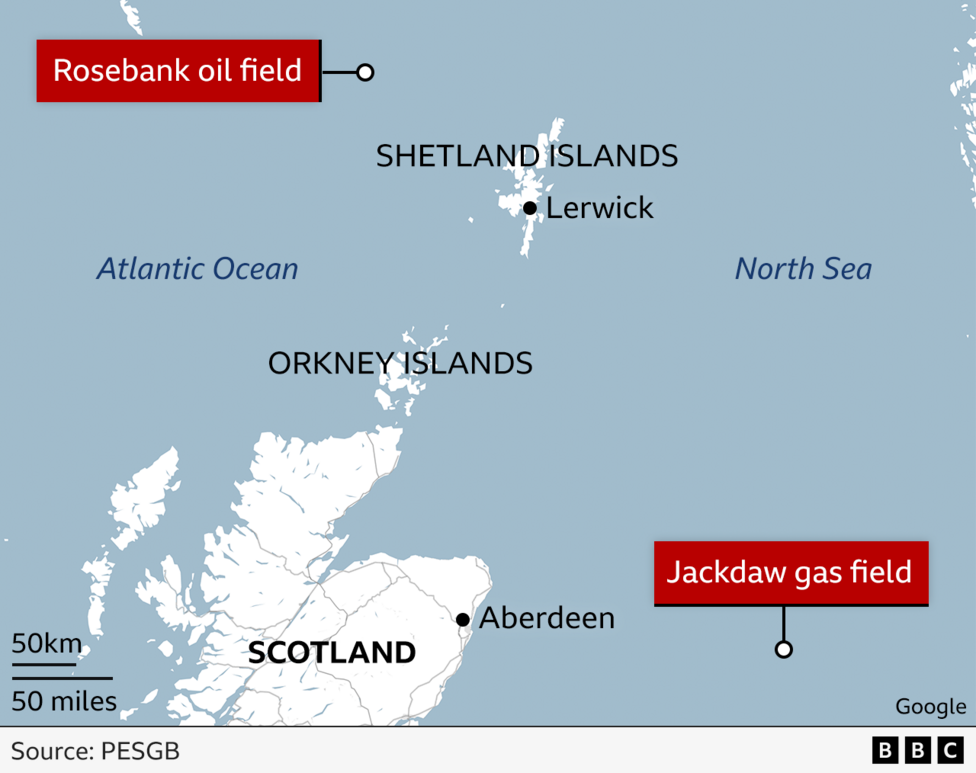
Jackdaw gas field is an offshore natural gas field in the central North Sea, about 240 kilometres (150 miles) east of Aberdeen. It lies in Blocks 30/02a, 30/02d and 30/03a and has been owned since 2025 by Adura, a joint venture equally owned by Shell and Equinor.
The field is being developed using a platform that is not intended to be permanently attended. It stands in about 78 metres of water, roughly 30 kilometres southeast of the Shearwater installation, to which fluids from Jackdaw are exported.
Approval and development
The UK government approved the field in 2022, but the project subsequently faced a High Court challenge and other legal delays. Approval was granted again in October 2026, allowing development to proceed toward supplying gas to Britain's network.
The operator estimates that Jackdaw contains around 10 million cubic metres of recoverable gas and could produce gas for about 11 years. Based on official projections cited in the news report, its potential output was estimated at roughly 1.6% of total UK gas demand projected between 2026 and 2036.
Public debate
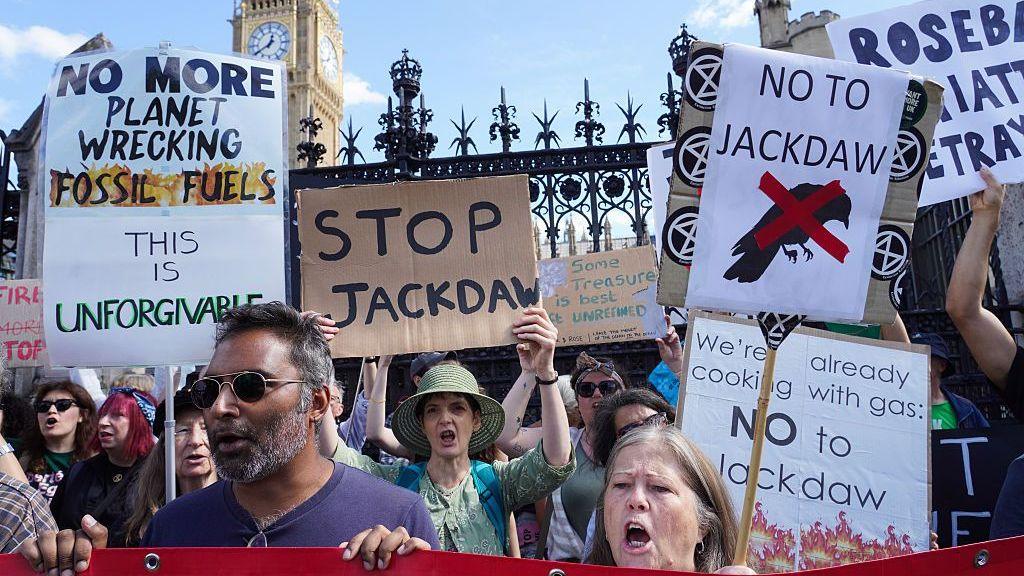
The renewed approval became part of a wider debate over UK energy security, household energy costs and climate policy. Energy Secretary Miatta Fahnbulleh said Jackdaw gas would not lower energy bills in the winter following approval, while analysts noted that British gas prices are closely linked to wider European markets rather than determined solely by domestic production.
Supporters have argued that additional North Sea production could reduce reliance on imported liquefied natural gas and support employment. The operator has estimated that the development could support around 500 jobs, including positions associated with nearby production hubs, while the Jackdaw platform itself would account for 27 direct roles.
The environmental effect is disputed. North Sea Transition Authority estimates cited in the report indicate that producing, transporting and processing US liquefied natural gas has substantially higher emissions than producing North Sea gas, while Norwegian pipeline gas has a lower average production-related emissions impact than existing UK North Sea gas. The overall effect of Jackdaw therefore depends partly on which imported supplies it displaces and whether it contributes to higher total fossil-fuel production and consumption.
Related translated reports
Jackdaw cleared for drilling: what the North Sea gas field can, and cannot, change for bills, energy security and emissions
The government has given the go-ahead for Jackdaw, with its gas due to reach Britain's network within weeks, yet analysts expect little direct relief for household bills. BBC Verify examines the field's scale, the jobs and tax revenue at stake, and the competing claims over security and the climate.
Drilling at the Jackdaw gas field in the North Sea has been approved by the government, drawing a line under years of argument and legal challenges. Once it is hooked up, the field's gas could be flowing into Britain's network within a matter of weeks. BBC Verify has examined what the decision means for household bills, the country's energy security and the environment. The field lies some 150 miles (241.4km) east of Aberdeen and belongs to Adura Energy, which is owned equally by the energy companies Shell and Equinor. It was first given consent four years ago, but legal action has held the project up ever since. Its owners estimate the site holds around 10 million cubic metres of recoverable gas. Measured against official forecasts of what the UK will need over the coming decade, that amounts to the potential to cover roughly 1.6% of the nation's projected gas demand between 2026 and 2036. The operators believe the field could be tied into the Great British gas network within weeks and keep producing for the next 11 years. For anyone hoping the decision might ease the pressure on household budgets, Energy Secretary Miatta Fahnbulleh has tempered expectations, saying the gas "won't lower energy bills this winter". Most energy analysts likewise do not expect Jackdaw's extra output to make any significant, direct difference to what households pay. The explanation lies in the structure of the market. Great Britain is woven into the broader European gas market and physically connected to the continent through undersea pipelines, which means the prices faced by British homes and businesses are effectively set at a pan-European level, driven by what customers across Europe are willing to pay. Bills have climbed sharply right across the continent in recent years, squeezed by the wars in Ukraine and Iran disrupting gas and oil supplies. Set against that, the additional volume Jackdaw will pump into the system is relatively small and unlikely to shift the European price that British firms and households end up paying. "Essentially, producing more British energy doesn't necessarily mean cheaper British energy," Karl Matikonis, professor of taxation at University College Dublin, told BBC Verify. "North Sea oil and gas are sold at market prices rather than reserved for British consumers at a discount." The likelier financial upside for the UK comes through taxation. Any profits the owner makes would be taxable, so higher production could deliver extra corporation tax revenue for the government. As part of its Jackdaw announcement, the government said it was creating a new energy wealth fund, financed by North Sea oil and gas tax receipts and aimed at green energy projects, which it said would "help get bills down for good in the long term" by cutting the UK's reliance on gas to generate electricity. Kemi Badenoch, the Conservative leader, has previously argued that the tax revenue from Jackdaw "could be used to bring down energy bills" instead, by removing costs from household bills directly. Both ideas, however, hinge on how profitable the field's owner turns out to be — something that cannot be forecast with any certainty. On jobs, Prime Minister Andy Burnham said opening the field would "protect hundreds of jobs", a position welcomed by the unions. By the owner's own estimate, the project will support around 500 jobs, including roles on production hubs nearby, though just 27 of them would be directly on the Jackdaw gas extraction platform in the North Sea. A headline argument for developing Jackdaw is that it would strengthen the UK's energy security — an issue on which the experts diverge. Around half of the UK's natural gas is already drawn from its existing North Sea fields and piped ashore. Imports cover the rest, most of it coming from Norway's North Sea fields through separate pipelines. A bigger share of imports than 20 years ago now arrives as Liquefied Natural Gas (LNG), which is extracted, converted to liquid form, shipped to the buying country and turned back into gas there for use as an energy source. The UK has also become increasingly dependent on LNG cargoes from the US, which accounted for a quarter of all natural gas imports in 2025. Some specialists argue that if, for whatever reason, foreign LNG shipments failed to reach the UK, having extra North Sea gas available and delivered through a pipeline the country controls could prove valuable. They note that confidence in the US as a dependable supplier has been shaken by Donald Trump's recent comments that he was considering banning exports of US diesel to European countries. Others remain unpersuaded, pointing out that even with the field up and running the UK would still lean heavily on gas imports, so Jackdaw would not make a significant difference to national energy security. The environmental consequences have proved equally divisive. Backers contend that gas produced from the UK's own North Sea field generates lower carbon emissions in production than gas produced from US LNG. The North Sea Transition Authority (NSTA), which regulates the industry, has estimated that the emissions from producing, delivering and processing US LNG are roughly three times higher than those from producing North Sea natural gas. The reason is that liquefying the gas, shipping it and turning it back into gas on arrival is extremely energy intensive, compared with pumping it ashore through a pipeline. There is a complication, however. NSTA estimates that Norwegian North Sea production, which Britain already imports in large volumes by pipeline, has a considerably lower average emissions impact than the UK's existing North Sea output — largely because UK gas mostly comes from smaller fields, extracted with older infrastructure and technology than Norway's. By its owner's estimate, the emissions intensity of Jackdaw's production would be lower than that of older UK North Sea infrastructure, while remaining higher than gas from Norwegian fields. The climate effect of the decision therefore depends partly on an uncertain future: how the UK's gas consumption mix evolves, and where the gas comes from. If Jackdaw's output displaces US LNG imports, UK-related national emissions could end up lower than they otherwise would be. If it displaces Norwegian imports instead, they could be higher. It is also worth remembering that the emissions produced by burning gas far outweigh those from producing it. Analysts add that if the decision ends up raising the total amount of fossil fuels produced and consumed worldwide, global emissions will be pushed up compared with what would otherwise have happened — even if UK-related emissions fall. "If what matters is global rather than UK-related emissions then any new fossil fuel development will increase emissions, because the Norwegian and US gas which might replace Jackdaw will probably be developed anyway," Jonathan Stern of the Oxford Institute for Energy Studies told BBC Verify. Even so, given how small Jackdaw is relative to the world's existing fossil fuel production and consumption, its direct impact on global emissions would still be relatively small.