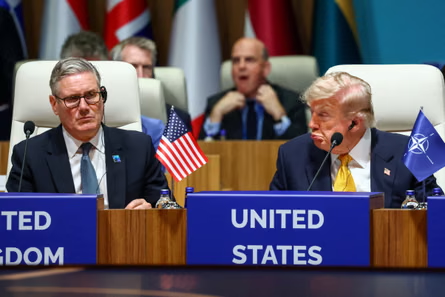
Keir Starmer
British Labour Party politician, former lawyer and Prime Minister of the United Kingdom from 2024 to 2026.
Also known as: Sir Keir Starmer · Sir Keir Rodney Starmer · Keir Rodney Starmer
Overview
Sir Keir Rodney Starmer (born 2 September 1962) is a British politician and former lawyer who served as Prime Minister of the United Kingdom from 5 July 2024 to 20 July 2026. A member of the Labour Party, he was its leader from 2020 to 2026 and served as Leader of the Opposition from 2020 to 2024. He represented Holborn and St Pancras in the House of Commons from 2015 to 2026.
Early Life and Legal Career
Starmer was born in Southwark, London, and raised in Surrey. He became involved with the Labour Party Young Socialists during his teenage years. He studied law at the University of Leeds, graduating in 1985, and subsequently earned a Bachelor of Civil Law degree from St Edmund Hall, Oxford, in 1986.
Before entering parliamentary politics, Starmer worked as a barrister, concentrating on criminal defence and human rights law. He served as a human rights adviser to the Northern Ireland Policing Board and became a Queen's Counsel in 2002. From 2008 to 2013, he was Director of Public Prosecutions. He was appointed a Knight Commander of the Order of the Bath in the 2014 New Year Honours for services to law and criminal justice.
Political Career
Starmer was elected Member of Parliament for Holborn and St Pancras in 2015. He became leader of the Labour Party in 2020, succeeding a period of Conservative government, and led the party into the 2024 general election.
Labour won a substantial parliamentary majority in that election, ending 14 years of Conservative rule. Starmer became prime minister on 5 July 2024, succeeding Rishi Sunak. He was the first Labour prime minister since Gordon Brown left office in 2010.
Premiership and Resignation
During Starmer's premiership, his government pursued policies involving public spending, energy, industrial relations and the criminal justice system. Its measures included changes to Winter Fuel Payments, an early-release programme intended to reduce prison overcrowding, settlements of public-sector strikes and the announcement of Great British Energy.
In 2026, Labour experienced a leadership crisis following disappointing local election results, disagreements over government policy and growing dissatisfaction within the party. Starmer announced his resignation on 22 June 2026. Andy Burnham succeeded him as Labour leader on 17 July and as prime minister on 20 July 2026.
European Relations and Security
Starmer has advocated closer cooperation between the United Kingdom and European countries on economic affairs, defence and security. Before leaving office, he argued that the changing international environment required stronger European partnerships and described Brexit as having caused significant economic damage to the United Kingdom.
After leaving Downing Street, Starmer reiterated these positions in a speech to the British Irish Chamber of Commerce in Dublin. He argued that changes in United States foreign policy under President Donald Trump reflected a lasting shift rather than a temporary interruption of established transatlantic relations.
Starmer warned that European countries could no longer assume that the United States would continue financing their security arrangements to the same extent as before. He cited Russia's invasion of Ukraine as evidence of weaknesses in European defence preparedness and called for a common European security framework involving both the European Union and countries outside it, particularly the United Kingdom.
He maintained that the military, security and intelligence relationship between Britain and the United States remained important, while arguing that European governments needed to accept greater responsibility for their own defence. He also emphasised cooperation between Britain, Ireland and other European partners in supporting Ukraine.
Personal Life
Starmer married Victoria Alexander, a former solicitor who subsequently worked in occupational health within the National Health Service, in 2007. They have two children.
Related translated reports
Former British Leader Urges Closer European Ties Amid Shifting US Landscape
In his first major address since stepping down from Downing Street, former Prime Minister Keir Starmer emphasized that European nations must strengthen their partnership because Washington can no longer be relied upon as it once was. Speaking in Dublin, Starmer argued that transatlantic shifts under Donald Trump represent a permanent transformation rather than a temporary blip, cautioning that Europe has already been caught off guard twice by failing to anticipate major geopolitical shocks.
Britain and its continental neighbors need to forge a much tighter alliance as the United States transitions into an increasingly unreliable ally, Keir Starmer stated during his inaugural major political address since leaving Downing Street. The former prime minister highlighted the persistent threat from Russia and stressed that the evolution in Washington's foreign policy during Donald Trump's tenure will persist long after the current president exits the Oval Office, accusing European capitals of being repeatedly blindsided by shifting global realities. Addressing an audience at the British Irish Chamber of Commerce on Friday, Starmer asserted that a robust Europe is indispensable and that the United Kingdom must anchor itself at the core of it. He remarked that Europe had twice missed critical warning signs, initially when the Russian invasion of Ukraine laid bare deep-seated security vulnerabilities, and subsequently when President Trump made it explicitly clear that America would no longer underwrite European defense. Before relinquishing office in July, Starmer had already advocated for deeper European integration. Just three months prior, amid rising tensions involving Iran and threats concerning NATO withdrawal, he described Europe as an essential alliance required to navigate an increasingly hazardous international environment. He maintained that these collaborative efforts should extend well beyond defense, pointing out that Brexit inflicted substantial harm on the British economy and expressing a desire for more ambitious engagement, encompassing both enhanced economic partnership and security collaboration. Starmer's remarks followed a series of engagements in Dublin where he conferred with prominent corporate figures and political officials, including Taoiseach Micheál Martin, with whom he previously instituted the annual UK-Ireland summit. Emphasizing the permanent nature of these geopolitical adjustments, Starmer noted that current developments reflect a structural transformation rather than a mere deviation tied solely to the Trump presidency, adding that previous diplomatic norms will not return. While clarifying that the transatlantic security, military, and intelligence partnership remains exceptionally strong, he stressed the necessity for European nations to assume substantially greater ownership of their own regional defense. These sentiments underscore a broader alignment within UK progressive politics regarding the necessity of European ties for national defense and economic stability. Shortly after succeeding Starmer, Andy Burnham signaled an intent to pursue a bolder approach toward EU relations. Burnham is slated to participate in an upcoming EU-UK summit next month, where discussions will center on potential pacts covering energy policies, food standards, and youth mobility. Furthermore, Burnham has advocated for an open national dialogue regarding future paths toward a closer association with the European Union following the subsequent general election. Concurrently, during a gathering of European defense chiefs in Paris, Defense Secretary Wes Streeting reaffirmed a collective and resolute commitment to supporting Ukraine against ongoing Russian aggression. Detailing his vision for regional architecture, Starmer called for enhanced pan-European coordination in security and defense, advocating for a shared security framework alongside a unified market. He noted that while the EU is adapting, the broader European perimeter remains vital to overall defense strategy, requiring action beyond the bloc alone. Highlighting Britain's pivotal capabilities, Starmer pointed to the nation's status as a nuclear power, a prominent NATO contributor, a participant in next-generation fighter jet development, and a guarantor of security in Ukraine alongside continental allies. Concluding his remarks in Dublin, Starmer observed that the UK and Ireland remain closely aligned within the coalition supporting Ukraine to safeguard continental stability, expressing confidence that cooperative security imperatives will reinforce Britain's ties with its international allies.