MAGA Inc.
American political action committee (super PAC) aligned with Donald Trump.
Also known as: Make America Great Again Inc. · Make America Great Again (MAGA) Inc.
Make America Great Again Inc., commonly abbreviated as MAGA Inc., is an American super PAC (independent expenditure-only committee) created to support political candidates and initiatives associated with Donald Trump and the Republican Party.
As an independent super PAC under U.S. election law, MAGA Inc. is permitted to raise unlimited sums of money from donors, corporations, and organizations to spend on independent political expenditures, though it is barred from direct campaign coordination. The organization relies significantly on high-net-worth megadonors and serves as a key financial vehicle in federal political campaigns.
Related translated reports
Trump ties Camp Lejeune payouts to a Republican midterm victory as his $400m blitz and a ‘shylock’ backlash shake the final stretch
Donald Trump said he will have spent $400m supporting Republican candidates by election day on 3 November, and warned a North Carolina rally that claims over contaminated drinking water at Camp Lejeune will be settled only if his party wins the House and Senate. His repeated use of the antisemitic slur 'shylock' while defending the Kansas senator Roger Marshall drew criticism and a pointed refusal by the Anti-Defamation League to name him, while former New York mayor Michael Bloomberg answered with $80m for Democratic midterm efforts. Elsewhere, the administration pushed to shift disaster costs onto states, announced a further $1.2bn deferral of California funding, honored the YouTuber Nick Shirley with a $10,000 check and a new fraud-tip bounty, and sent envoys shuttling between Oslo, Kyiv's allies and Moscow — all as a too-close-to-call Kansas Senate race raised the prospect of the state's first Democratic senator since 1932.
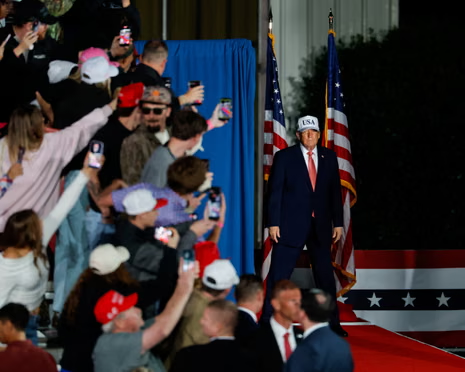
With election day on 3 November fast approaching, the money race is reaching extraordinary sums on both sides. Donald Trump said he will have spent $400m supporting Republican candidates in midterm races by the time Americans vote, with the money routed through his political operation and the aligned super pac Maga Inc. 'More than 300 Million Dollars has already been spent on Advertising, Direct and Indirect Voter Contact, Rallies, Rally Arenas, Telerallies, Get Out the Vote Programs, Election Integrity, and more. It is my Great Honor to do so on behalf of the Republican Party, which has done so much to bring our Country back from the Edge of Oblivion,' he wrote on Truth Social. He cited his belief in the Republican party — and the riots that have swept France, whose causes he has repeatedly and baselessly blamed on mass migration — as his reasons for the outlay. On the other side of the ledger, the former New York City mayor Michael Bloomberg, now 84, is donating $80m to Democrats ahead of the elections, the New York Times reported on Tuesday, with at least $50m of it earmarked for House races as he focuses on securing a Democratic majority in the chamber. 'He believes in participation in our democracy. And obviously the scale of his participation, given his resources and his means, is greater than other people's financially. But other people are participating in different ways,' Bloomberg's adviser Howard Wolfson told the paper. 'He is of the view that resources matter in campaigns,' Wolfson added, noting that Bloomberg 'expects a result'. The House minority leader, Hakeem Jeffries, indicated the support would prove decisive again: 'Mayor Bloomberg played an incredibly instrumental role in the decisive midterm election in 2018. The extraordinary support from Mayor Bloomberg will once again help Democrats flip the House.' Trump also attached the starkest electoral condition of the day to long-running compensation claims from Camp Lejeune. At his rally in Greenville, North Carolina — part of a seven-day tour to stump for Republicans ahead of the midterms — he told supporters there will be 'no money' to settle claims over water contamination at Marine Corps Base Camp Lejeune if Republicans are not victorious in the upcoming elections. 'If we win the House and the Senate, I am directing the Department of Justice to settle all remaining legitimate claims as soon as possible, and get it off the books and get it finished,' he said. 'If we don't win, there's no money. If we do win, you're getting it and it's gonna be finally over with, that nightmare that's been going on for so many years.' The base was built in the early 1940s, and from the early 1950s to the late 1980s its drinking water was contaminated with industrial solvents. Trump said his administration has so far delivered $1bn in settlements to impacted veterans and their families. His remarks were only the latest instance of the president suggesting he would punish Americans for failing to vote the way he wants: while in Kansas on Monday, he said he would not allow year-round sales of gasoline containing higher volumes of ethanol if the state's voters elect a Democrat over the Republican senator Roger Marshall. The Camp Lejeune comments also opened a public rift on the right. Laura Loomer, the Trump loyalist and rightwing influencer, tore into the Department of Justice on Tuesday, saying the agency was belittling veterans who were exposed to contaminated drinking water at the Marine Corps base decades ago with 'lowball' settlement offers. 'This is a political disaster waiting to happen. Let's be clear: Democrats are 100% going to weaponize this against President Trump and try to hurt him with veterans heading into the midterms in two weeks,' she wrote in an X post, blaming the associate attorney general Stanley Woodward Jr. The attorney general, Todd Blanche, responded in a thinly veiled rebuff that appeared to suggest Loomer's diatribe was financially motivated. 'You should be transparent with your followers, and you are dead wrong about Stanley,' he wrote on X. 'We love our veterans and we want to get these cases right. Find a different obsession other than going after one of DOJ's best fighters.' Loomer shot back, saying Trump wanted to fire Woodward but took pity on him 'because his lefty wife is divorcing him,' she claimed. Bloomberg and some other outlets reported earlier this year that Harmeet Dhillon, an assistant attorney general in the DOJ's civil rights division, would be promoted to Woodward's post. She was not. The day's most charged controversy centered on a word. At a rally outside Wichita on Monday night, Trump invoked the antisemitic stereotype 'shylock' as part of his defense of Marshall, a doctor who has been criticized for filing lawsuits against more than 700 patients with outstanding bills, leading to 18 of them being arrested. The outburst came after Trump had endorsed Israel's prime minister, Benjamin Netanyahu, ahead of Israel's elections. The president began by claiming, falsely, that Marshall had been required by law to take legal action over unpaid bills — even one for just $101. Marshall 'was given a bum rap because he was mandated by law to request strongly, money owed from patients. You're not allowed not to do it. You have to, by law, go after those people,' Trump told supporters. There is, in fact, no such law. Turning to the senator's critics, including his Democratic rival Adam Hamilton, who has featured some of Marshall's patients in a campaign ad, Trump said: 'they made it like, oh, he was some kind of a Shylock-type guy.' 'If he didn't make these requests, he would be breaking the law,' he said again, repeating the falsehood on which his defense rested. 'He would have been breaking a very strong criminal law, and he would be subject to criminal arrest and liability,' the president claimed, falsely. It was not the first time. Fifteen months earlier, speaking at a rally in Iowa on 3 July 2025, Trump said eliminating taxes on inherited family farms would save farmers from 'going to the banks and borrowing from, in some cases a fine banker, and in some cases shylocks and bad people'. The day after that rally, the ADL called the president's use of the term 'very troubling and irresponsible'. When a reporter asked if he had intended 'shylocks' to refer to Jews, Trump claimed ignorance. 'No, I've never heard it that way,' he replied at the time. 'To me, a shylock is somebody that's a, uh, a moneylender at high rates. I've never heard it that way. You view it differently than me. I've never heard that.' This week, the Anti-Defamation League — founded in 1913 'to protect the Jewish people' and self-described as the world's 'leading anti-hate organization' — denounced the term as antisemitic, without mentioning that Trump had used it a day earlier in Kansas. In a brief post on X, though not its other social media accounts, the group said: 'The term "Shylock" is rooted in a longstanding antisemitic stereotype. Regardless of intent, its use can reinforce harmful tropes about Jews and normalize language that has long been used to target the Jewish community.' The group offered no explanation as to why it found it necessary to explain, that day, that anyone equating an avaricious person with Shylock — the villainous Jewish moneylender in Shakespeare's Merchant of Venice — is invoking an antisemitic trope. Critics who accuse the ADL of deploying accusations of antisemitism selectively, to attack people who are critical of Israel, suggested the Jewish-American civil rights group was going easy on Trump because of his support for Israel. Matt Duss, a former foreign policy adviser to senator Bernie Sanders, the most prominent Jewish American politician, seized on the omission. 'If a Democrat said it Jonathan Greenblatt would be knocking people over to get in front of a camera to condemn them by name, but it was Trump so it's just a general public service announcement,' Duss wrote. The reticence stood in contrast to 2014, when the ADL's national director accepted an apology from then vice-president Joe Biden — who had described people who take financial advantage of American service members as 'shylocks' — and called the remarks 'a teachable moment'. Trump's North Carolina rally was devoted to boosting Michael Whatley, the Republican nominee for US Senate, who is polling behind Roy Cooper, the state's former Democratic governor. The president mostly stuck to a familiar script, repeating conspiracy theories about paid protesters and peddling falsehoods about Cooper's tenure as governor. He suggested, erroneously, that crime in North Carolina rose under Cooper because some 3,500 inmates were released during the pandemic; the releases came with the agreement of Cooper's administration as part of a settlement with civil rights groups. Several demonstrators were removed from the event, among them one protesting high gas prices. Trump called them 'losers' and claimed that their parents were probably his supporters and would physically punish them for the disruptions. The president also spoke at length about the Ohio senator Jon Husted, whom he described as a 'football stud'. 'I'm studying his body. I've never studied the body of a man before, it's not my thing,' he said. 'But I looked at his ass and then I looked at his legs and I said, "His ass — it's like a pile of muscle." Then I looked at his legs and I said, "Man, his feet are big."' The commerce secretary, Howard Lutnick, briefly came on stage to announce new investment supporting semiconductor production in North Carolina. 'We're announcing Sibelco is going to build silicon manufacturing. It's quartz manufacturing. It is basically the foundation of semiconductors,' he said during the event, putting the amount at 'hundreds of millions of dollars'. The Senate contest Marshall is defending has itself become startlingly competitive. Republicans are scrambling to retain their dominance in Kansas just two years after Trump won the state by 16 points in his fight to regain the White House, and the battle for one of its two Senate seats is too close to call. Some recent polls even put the Democrat Adam Hamilton on course for a historic victory in a state that has not sent a Democrat to the Senate since 1932. On the trail, Hamilton — the senior pastor of the country's largest United Methodist congregation, a role that brings name recognition and speaking skills — regularly points to one of Kansas's most famous residents: Dorothy from The Wizard of Oz. Recalling a visit to Liberal, Kansas, and its Oz museum, he asks audiences to recall what Dorothy's companions on her journey needed: the lion courage, the scarecrow a brain and the tin man a heart. Washington needs more of all three, he says, and he can deliver it. He told a crowd of business leaders in Topeka on Friday, in the energetic cadence of the pastor he is, that he decided to run after seeing the Trump administration act in ways that were 'not good or kind or compassionate or humble', while he waited for Marshall to stand up for his state and its people. 'I would have arguments with Roger Marshall in the shower. He was not in the shower with me,' Hamilton joked. 'And I would just say, Roger, please stand up for your people. You were not hired to be a spokesperson for the White House. You were hired to fight for your people.' The incumbent's own liabilities — he sued hundreds of his patients for unpaid bills, resulting in the arrests of dozens of them — have contributed greatly to Hamilton's prospects of flipping the seat. Electorally, Hamilton is courting independents and Republicans, calling himself an independent-minded Democrat, and told the business leaders it would be valuable for Kansas to have both a Democrat like him and the Republican Jerry Moran representing the state in the Senate, working both sides of the aisle. Away from the campaign, the administration is engineering a shift in disaster finance, Politico reports. 'Federal dollars should be building greater capability, not creating greater dependency,' the Federal Emergency Management Agency administrator, Cameron Hamilton, told state officials at an Arkansas conference, in a recording exclusively obtained by the outlet. He said each state should have the 'appropriate financial reserves'. 'A future that I hope we would shoot for is one where we wouldn't require as many disasters because the capability of states is so high and so substantial,' he added, noting that changes could begin in the next six months. Under Trump's second administration, FEMA has seen deep cuts in funding and the exodus of over 2,400 personnel, and former employees and emergency response experts have voiced concern over its capability to respond to future natural disasters. In the Oval Office, Trump announced an incentive program for people to report fraud, in honor of the conservative YouTuber Nick Shirley, who posted a video last year alleging fraud by daycare centers serving Minneapolis's Somali American community. The video, initially posted in December, resulted in a deluge of anti-immigrant and anti-Somali content across social media, including Truth Social posts by Trump himself. Under the administration's proposed program, people who submit information that results in a fraud conviction could receive up to $30,000, and the president presented Shirley, 24, with a check for $10,000 for his work. The backdrop: more than 90 people in Minnesota have been charged since 2022 in a $250m Covid-19 relief fraud scheme involving a non-profit that falsely claimed to provide meals to children, and a federal prosecutor has estimated that $9bn or more in federal funds across 14 state programs may have been stolen since 2018. In July, Fahima Egeh Mahamud, the CEO of the daycare center that appeared in Shirley's video, pleaded guilty to wire fraud and conspiracy to defraud the US. Trump also launched another racist attack on the Democratic congresswoman Ilhan Omar and the Somali American community, doubling down after the Justice Department raided the Minnesota representative's Washington DC home earlier this month. Reports citing sources familiar with the probe said the search was related to a criminal fraud investigation concerning Omar's immigration paperwork, which her father filled out when she was a child. The raid has been met with widespread condemnation, particularly so close to the midterm elections. 'I think she's a sick, a very dishonest person, but who hates our country. And she comes from a country that is essentially not even a country, Somalia. It's a real shit house,' Trump said. 'Somalians vote for her … Most of them shouldn't be here. You know, they have like a 98% unemployment rate. They don't work,' he added — an incredible statistic given that the census does not actually track the unemployment rate for Somali Americans specifically. In the Oval Office, meanwhile, Mehmet Oz — the director of the Centers for Medicare & Medicaid Services — announced that the health department would be deferring $1.2bn more to California, after the Trump administration already paused almost $1bn in Medicaid funding to the Golden State in July. 'They just got the note, and we're doing that because the growth of personal care services in California,' Oz told reporters on Tuesday. 'That one little area where you're paying someone to carry groceries upstairs for your mom, which many of you would carry groceries upstairs for your mom for free, I would think. But in California, they'll pay you a lot of money for it, and it's actually run by the counties. But California has been growing that program 24% in the last three years.' Beyond Washington, Trump's special envoys Steve Witkoff and Jared Kushner wrapped up a meeting with Nordic leaders and the Ukrainian president, Volodymyr Zelenskyy, in Oslo. Zelenskyy said the talks covered security guarantees, among other subjects, and that he hopes to hear Russia's response tomorrow. Witkoff is set to head to St Petersburg on Wednesday to relay the new peace proposals discussed with Ukraine to Moscow. Zelenskyy also said that US intelligence sharing with Ukraine is working again, after sustained disruptions; earlier, he said he had a 'substantive conversation' with the US secretary of state, Marco Rubio. Rubio, for his part, told reporters in India that 'there has not been some deliberate political directive to go out and harm Ukraine'. He called the assertion that people in Ukraine are dying because the US is denying them information 'scandalous' and 'outrageous'. In an interview with CNN, the Democratic congressman Eugene Vindman of Virginia slammed the secretary of state's comments. 'He [Rubio] is lying and so is the president when they say that they are not restricting intelligence in violation of the law,' Vindman said. Trump himself was not optimistic about whether peace talks appear to be back on the table ahead of Witkoff's St Petersburg meeting, which follows the Oslo summit. 'Russia is a big machine. They just keep grinding forward, and that's what they've done. They've taken a very large piece of land, and you know you can say that Ukraine is doing well or poorly, but the land gets bigger and bigger all the time, week by week,' he said, before repeating his insistence that Zelenskyy cut a deal. 'We have given tremendous amounts to Ukraine. We've got nothing back, other than high diesel,' Trump said, without acknowledging that the price of diesel and gasoline jumped at the beginning of the Iran war in February. 'We want Zelenskyy to make a deal. He can make a deal … In my opinion, it's just really just going to get worse.' On France, the president once again said — without providing any evidence — that the riots there are due to mass migration. 'It's an immigration problem. You have people that poured into France, and they were also unchecked, unvetted, like with Biden when he was doing. We don't do that,' Trump said. French authorities have not tied the upheaval, which has descended into chaos and seen thousands arrested, to immigrants, but that has not deterred the president from insisting that similar chaos would be the US' fate if Democrats win control of Congress in the upcoming midterms. A survey released on Tuesday laid bare the cultural terrain on which the election is being fought. The nonpartisan Public Religion Research Institute's annual American Values Survey reveals a widening 'empathy gap' between Republicans and white evangelicals, on one side, and the rest of the American public on the other. White evangelical Protestants are the only religious group in which a majority does not agree that empathy is a foundational moral value, with 42% agreeing, PRRI said; instead, a majority (54%) say empathy can be dangerous when it leads people away from a society guided by God's truth.