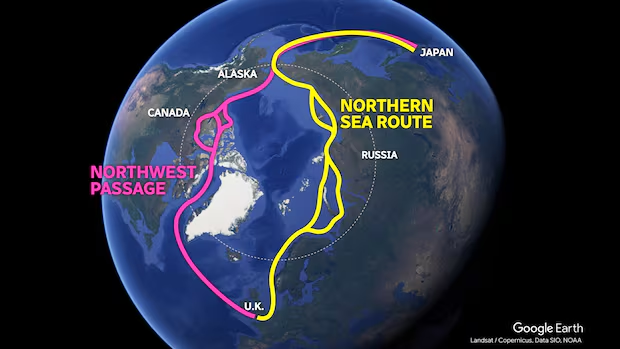
Northern Sea Route
An Arctic shipping route along Russia's northern coast used for Russian oil and LNG exports and considered a shorter but ice-prone alternative to traditional routes.
Also known as: NSR · Severnyy morskoy put · Sevmorput · Северный морской путь
Overview
The Northern Sea Route (NSR; Russian: Severnyy morskoy put, often shortened to Sevmorput) is an Arctic shipping route about 5,600 kilometres (3,500 mi) long. It runs along Russia's Arctic coast from the Kara Strait, at the boundary between the Barents and Kara Seas, to the Bering Strait, and straddles the Kara, Laptev, East Siberian and Chukchi Seas. It is the shortest shipping route between the western part of Eurasia and the Asia-Pacific region.
Administratively and geographically, the NSR lies in Arctic waters within Russia's exclusive economic zone and is included in the Northeast Passage. It does not include the Barents Sea and therefore does not reach the Atlantic Ocean. Because the NSR covers most of the Northeast Passage, the terms are sometimes used interchangeably. The route serves Arctic ports and major Siberian rivers.
Relevance in 2026
In 2026, Russia's oil exports through the NSR exceeded the previous year's total by nearly 50 per cent by mid-October, with about 20 million barrels shipped to Asia from the start of navigation in July. Traders said the route became more attractive amid disruptions to routes in the Suez Canal, the Strait of Hormuz and the Black Sea area, and amid high tanker freight rates. The NSR requires icebreaker assistance and is considered more dangerous and expensive than usual routes, but in 2026 its high tariffs were less costly compared with the usual route to Asia through the Red Sea.
For Russia, which controls the NSR, the route provides a secure alternative to European waters, where tankers carrying Russian oil have been regularly arrested during 2026. Traders' preliminary estimates expected volumes to rise by another five to 10 million barrels before the end of the navigation period, while Russia had shipped 13 million barrels during the last navigation season. Gazprom Neft said it would increase shipments via the NSR by about 35 per cent in 2026 compared with 2025. Russia also supplies significant volumes of liquefied natural gas (LNG) and other goods via the NSR, and President Vladimir Putin said Russia expects cargo turnover via the route to double to 70 million tonnes annually by the end of the decade. Rosneft's Vostok Oil project has contributed to rising volumes.
Related translated reports
Russian oil exports by Arctic route jump amid world freight crisis, data shows
Russia's oil exports through its Northern Sea Route in 2026 have already exceeded last year's by nearly 50 per cent.
Russia's oil exports through its Northern Sea Route (NSR) in 2026 have already exceeded last year's by nearly 50 per cent, with some 20 million barrels shipped to Asia from the start of navigation in July to mid-October, traders said and data showed. The NSR links Russia's western ports with Asian markets through icy Arctic waters and is considered a more dangerous and expensive route. This year, however, it became more attractive as a result of disruptions to routes in the Suez Canal, the Strait of Hormuz and the Black Sea area, traders said. Tanker freight rates have soared to record highs as wars with Iran and in Ukraine have stoked inflation and put U.S. crude oil out of reach for Asian refiners, driving them to seek alternatives from the Middle East and Latin America. This made high tariffs for ships using the NSR, which requires assistance from an icebreaker, less costly compared with the usual route to Asia through the Red Sea, traders said. For Russia, which controls the NSR, it represents a secure alternative to European waters, where tankers with its oil have been regularly arrested this year. The volume of Russian oil exported through the Arctic route is expected to rise by another five to 10 million barrels by the end of the navigation period, traders' preliminary estimates show. Why North America is preparing for an Arctic battle | About That Russia shipped 13 million barrels during the last navigation season. Gazprom Neft, one of Russia's major oil companies, will increase its shipments via the NSR by some 35 per cent this year compared with 2025, its CEO Alexander Dyukov told journalists on Friday in Moscow. Russia also supplies significant volumes of liquid natural gas (LNG) to Asia via the NSR as well as other goods. LNG supply via the NSR is also expected to rise this year after the launch of Arctic LNG shipments. President Vladimir Putin told an economic forum in Vladivostok in September that Russia expects cargo turnover via the NSR to double to 70 million tonnes annually by the end of the decade. Rosneft's giant new oil project in the north of Russia, Vostok Oil, which opened last month, is already contributing to the rising volumes using the NSR.