Starlink
A low Earth orbit satellite internet constellation operated by SpaceX, providing global broadband services and extensively utilized for civilian and military communications in Ukraine.
Also known as: Starlink Services LLC
Overview
Starlink is a satellite internet constellation operated by SpaceX, a telecommunications subsidiary providing broadband internet service across approximately 160 countries and territories. SpaceX began launching Starlink satellites in 2019, utilizing a network of low Earth orbit satellites that communicate with user terminals and gateway ground stations. As of October 2026, the constellation consisted of approximately 11,150 satellites in orbit, accounting for a significant majority of active maneuverable satellites in Earth orbit.
Application in the Russo-Ukrainian War
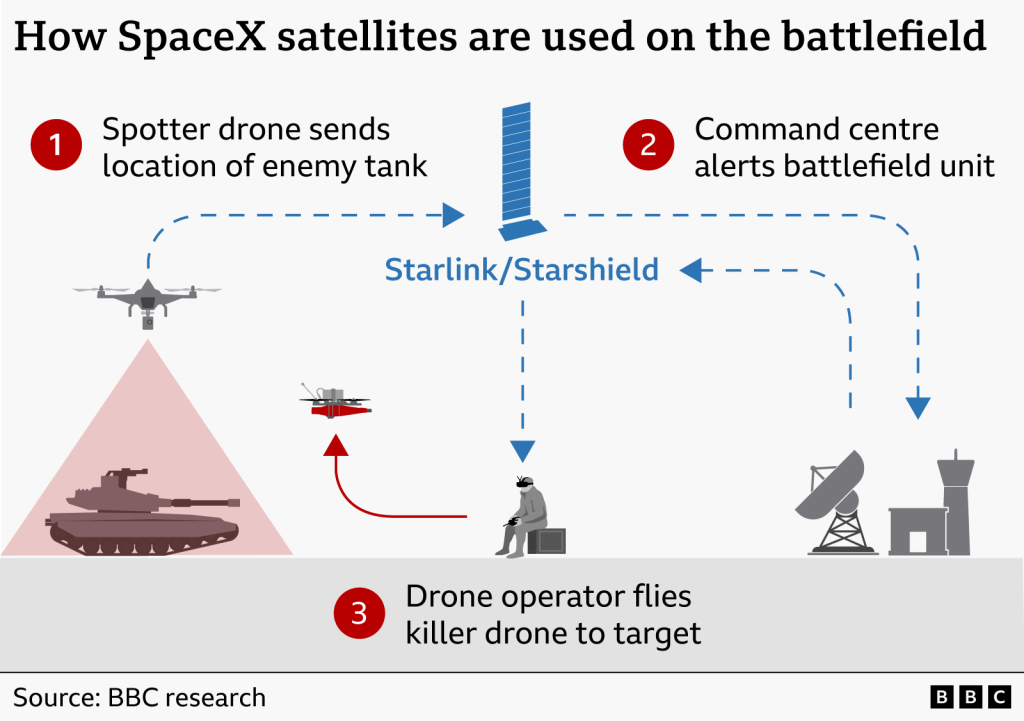
Following the full-scale Russian invasion of Ukraine in February 2022, SpaceX activated its Starlink service in the country to replace degraded or destroyed communication networks. The civilian commercial service has been used extensively by the Ukrainian military for battlefield communications, logistics, and coordinating defense operations. Alongside Starlink, a classified military-grade derivative known as Starshield operates for government and military purposes.
Operations have faced restrictions and geopolitical scrutiny. SpaceX previously restricted connectivity and imposed speed limits—such as a limit of 160 km/h—disrupting certain combat missions. Elon Musk stated that the service was restricted due to alleged violations of terms of service regarding offensive drone strikes, drawing responses from Ukrainian officials and international stakeholders amid broader diplomatic developments.
Related translated reports
SpaceX Limited Starlink Access for Ukraine, Musk Confirms Following Restoration
Elon Musk acknowledges that SpaceX restricted Ukraine's internet network, alleging it breached rules by deploying the system for military offensives, even as connectivity returned.
Elon Musk has acknowledged that SpaceX intentionally curtails Ukraine's Starlink connectivity, speaking out after Ukrainian authorities confirmed that service disruptions had ended. The billionaire entrepreneur argued that Kyiv breached user agreements by employing the network for military operations, though he disclaimed any involvement with concurrent disruptions affecting its American-administered, defense-grade equivalent, Starshield. While Kyiv has not issued an official response to Musk's latest statements, presidential adviser Serhii Beskrestnov dismissed the remarks as "very strange". Previously, Musk had denied intentionally throttling the connection, which Ukrainian authorities stated had impaired defensive capabilities for over a week. These connectivity troubles arose amid broader diplomatic friction between Washington and Kyiv concerning Ukrainian assaults on Russian petroleum facilities. The recent remarks from Musk, alongside the apparent return of full service, followed statements from US President Donald Trump indicating he instructed the Tesla and X leader to "put it back," despite repeatedly denying any role in restricting the network. Writing on X on Saturday, Musk stated: "Using Starlink, a civilian commercial service, for offensive drone strikes to kill people has never been allowed, nor should it be." He further asserted that the Ukrainian military violated terms by utilizing the network for offensive drone attacks, noting that this loophole was closed the prior week. He maintained that SpaceX had contributed more to defending Ukraine than any private enterprise globally and reiterated that Starshield operates as a distinct system managed by the United States government, leaving decisions regarding its use entirely to them. In a follow-up post, he noted that while Starlink can support military infrastructure, it cannot facilitate explicit offensive attacks that make it a legitimate target for retaliation. Responding on Telegram, Beskrestnov pointed out that Starlink-connected drones in Ukraine face built-in velocity caps of 70 to 90 km/h (43 to 56 mph) and do not function inside Russian territory. Consequently, he argued, it is physically impossible to utilize commercial Starlink for medium-range or deep strikes, expressing perplexity that Musk appeared unacquainted with these built-in limitations. Ukraine's defense ministry did not immediately issue a statement. Both services—the commercial Starlink and the higher-security Starshield—rely on SpaceX low Earth orbit satellite constellations to meet different operational needs. Starlink facilitates tactical coordination in remote battlefield zones, whereas Starshield grants drone pilots real-time target visualization and control over interceptor units. Because Russian forces are barred from using Starlink, long-range Ukrainian drones or missiles targeting deep Russian infrastructure experience network blackouts. Ukrainian Defence Minister Yevhenii Khmara reported earlier Saturday that forces registered a stable connection, enabling drones to achieve velocities exceeding 400 km/h after prior cutoffs occurred above 161 km/h. President Volodymyr Zelensky confirmed on Telegram that speeds had returned to required levels. Musk did not explain why the company implemented the adjustment last week despite years of widespread military reliance on the network. The slowdowns coincided with diplomatic friction between Zelensky and Trump over strikes targeting Russian oil assets, which Washington argued increased global fuel prices—though officials noted overall annual increases stemmed primarily from the war in Iran. Faced with upcoming midterm elections and domestic discontent regarding fuel costs, Trump has lifted certain sanctions on Russia and arranged an agreement to supply Russian diesel to domestic and global markets, a pact critics argue indirectly bankrolls Moscow's war effort. Zelensky initially agreed to halt strikes on Russian oil installations provided Moscow ceased attacks on Ukrainian energy grids, but resumed operations after repeated violations by Russia. The Ukrainian leader also asserted that the US threatened to cut off intelligence sharing alongside the Starlink restrictions unless refinery strikes ceased, an allegation also denied by Trump. Meanwhile, cross-border bombardments persisted overnight. Emergency services reported three fatalities and fifteen injuries—including an 11-year-old girl—following strikes in the southeastern Dnipropetrovsk region, while a separate drone hit a residential building in Vinnytsia, injuring six. The Russian defence ministry announced Sunday that it targeted a cargo vessel allegedly carrying supplies for the Ukrainian army toward the Black Sea port of Chornomorsk, alongside logistics centers and terminals in Kharkiv. Conversely, Ukraine's defence ministry reported hitting an enterprise operated by a sanctioned heavy machinery manufacturer in Oryol, where local authorities confirmed three deaths. The full-scale conflict entered its fifth year following Russia's invasion in February 2022.