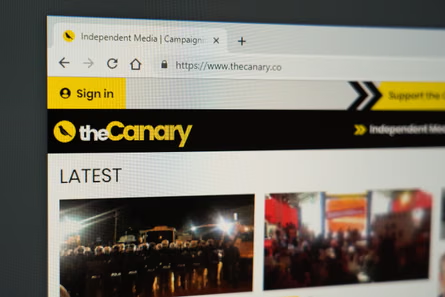
The Canary (news website)
A left-wing UK news website founded in 2015 that announced indefinite closure in 2026 after funding difficulties, internal allegations and attacks it described as malicious.
Also known as: The Canary · Canary · The Canary (website)
Overview
The Canary (news website) was a left-wing UK-based news site founded in 2015 by Kerry-Anne Mendoza and Nancy Mendoza. It was established at the height of support for the then Labour leader Jeremy Corbyn. The site focused on UK political affairs and also covered global, science, environment and health news, while including a satirical section. It described itself as an anti-austerity, anti-Zionist and pro-freedom of expression platform.
Development
The site grew in popularity around the 2017 United Kingdom general election. It was initially funded through advertising and a group of about 1,500 supporters, and by 2020 it had moved to a largely reader-funded model. In June 2022 it briefly became a worker cooperative after staff removed the management team over allegations of inequalities and mismanagement. In July 2022, Press Gazette reported that it was the third most popular politics news website in the UK, behind Politico and Politics Home. In 2025 it received investment from a northern Irish businessman, which it used to buy other websites and launch a print tabloid.
Closure announcement
In summer 2026 the outlet reported that Lloyds Bank and Metro Bank had blocked access to its bank accounts and that it had suspended operations. It later announced that it would close indefinitely, saying its situation had become unsustainable financially and operationally. The site alleged that it had faced malicious lies, defamation and harassment from former employees, as well as constant attacks by the state.
Internal allegations
Some journalists at the Canary said they believed the banking problems had been used to distract from wider financial mismanagement. They claimed that additional funding received over the summer, believed to be more than £2m, had been spent on projects including a short-lived newspaper and the purchase of other websites. Staff were told that the additional funding had almost all been spent and that they faced possible redundancy, with about £400,000 earmarked to guide operations through the rest of the year. About 50 full- and part-time staff formed a branch of the National Union of Journalists. Employees also alleged late pension contributions reported by Nest and that they had been asked to sign non-negotiable non-disclosure agreements. Steve Topple, the outlet's chief executive, said permanent employees had been paid up to date, though outstanding holiday payments were being clarified, and that all employees' pension contributions and freelancer payments were up to date as of 30 September. He had also told staff in May that he and others in management had serious concerns about the integrity of the organisation and reputational risk.
Related translated reports
The Canary news website announces closure after ‘vicious campaign against us’
Leftwing outlet said it had faced ‘multiple attacks’ and ‘malicious lies’ which made its situation unsustainable Business live – latest updates The leftwing news site the Canary has announced that it is closing indefinitely. Earlier this year the media outlet was blocked from accessing funds and has faced allegations of internal turmoil . The outlet, founded in 2015 at the height of support for the then Labour leader, Jeremy Corbyn, said in a social media post it would be closing “for the foreseeable future”. Continue reading...
The leftwing news site the Canary has announced that it is closing indefinitely. Earlier this year the media outlet was blocked from accessing funds and has faced allegations of internal turmoil . The outlet, founded in 2015 at the height of support for the then Labour leader, Jeremy Corbyn, said in a social media post it would be closing “for the foreseeable future”. The announcement also included allegations that the title had faced “malicious lies” by former employees. It said such claims had been part of “multiple attacks” it had faced which had made its situation “unsustainable, both financially and operationally”. In a statement, the Canary said: “After 11 years, we take this action with deep sadness and regret. The extent of the lies, defamation, and harassment by ex-staff – coupled with the constant attacks by the state and those who’d see us destroyed – has become too much.” The outlet, which describes itself as an anti-austerity, anti-Zionist and pro-freedom of expression platform, said it would be closed indefinitely. However, it added: “It is not over. This week, we will publish what really happened at the Canary and push back against the vicious campaign against our team and us. We may be down, but we’re not out yet.” Its challenges have included difficulties in paying staff and contractors , which it said was the result of Lloyds Bank unexpectedly blocking access to “a substantial amount” of its money earlier this year. However, some journalists at the Canary have said they believed the outlet’s banking issues had been used to distract from wider financial mismanagement. They claim that additional funding received over the summer – believed to be more than £2m – had been squandered on projects including a short-lived newspaper and the purchase of other websites. Steve Topple, the outlet’s chief executive, told staff in May that he and others in the management team had serious concerns about the integrity of the Canary as an organisation “and also the level of reputational risk”. There are understood to be about 50 full- and part-time staff at the Canary. They have formed a branch of the National Union of Journalists (NUJ). Staff were told over the summer that the additional funding had almost all been spent and they were facing the possibility of redundancy. At that point, they were told there was about £400,000 earmarked to guide the Canary’s operations through the rest of the year. The Canary then faced problems accessing its funds. Staff said they had been notified that late payments of pension contributions by the company had been reported by the National Employment Savings Trust (Nest), the government-backed workplace pension scheme that helps employers meet their legal duty of automatic enrolment. Employees have also alleged that earlier this year, they were asked by management to sign “non-negotiable” non-disclosure agreements and told that if they refused they would be subject to changes to their employment contracts. Topple said all permanent employees had been paid up to date as of today, “though we’re still clarifying some outstanding holiday payments owed”. “All employees’ pension contributions are up to date as of 30 September,” he said. “As for freelancers, all have been paid up to date as of 30 September.”