Yellow vests movement
A populist, grassroots protest movement in France that began in 2018 over fuel taxes and cost of living, and resurged in 2026 amidst rising prices and public service deficits.
Also known as: Mouvement des gilets jaunes · Gilets jaunes
The yellow vests movement (French: Mouvement des gilets jaunes) refers to a series of populist, grassroots weekly protests in France. The movement initially emerged on November 17, 2018, driven by opposition to rising fuel prices, high costs of living, and economic inequality. It is characterized by its leaderless structure and the use of the mandatory yellow reflective safety vest as a symbol of working-class distress. After a period of decline, the movement experienced a significant resurgence in late 2026 amid new waves of unrest over inflation and public services.
Origins and Initial Protests (2018–2020)
The movement was catalyzed by an online petition launched in May 2018 by Priscillia Ludosky, which called for lower taxes and higher wages. In October 2018, Jacline Mouraud posted a viral Facebook video opposing the government's proposed eco-tax on fuels. These digital mobilizations culminated in mass demonstrations starting November 17, 2018.
Protesters argued that the tax burden disproportionately affected the working and middle classes, particularly those in rural and peri-urban areas who relied on cars for commuting. On November 29, 2018, a list of 42 demands was published, covering topics such as fiscal justice, democracy, and social rights. Some protesters explicitly demanded the resignation of President Emmanuel Macron. The initial phase of the movement lasted until June 28, 2020, and was marked by frequent clashes between demonstrators and police, as well as violence involving far-right groups and black bloc anarchists.
Resurgence in 2026
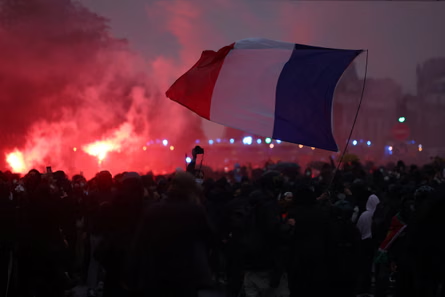
In September 2026, protests erupted across France driven by soaring fuel prices linked to the Iran war fuel crisis and broader economic instability. This wave saw a revival of the yellow vests identity, with activists joining forces with trade unions, students, and other civic groups. A major nationwide mobilization occurred on October 17, 2026, drawing hundreds of thousands of participants. While many demonstrations were peaceful, the event escalated into widespread riots, looting, and arson in Paris and other cities, described by some officials as the worst civil unrest in France since May 1968.
Following the October riots, the movement continued to influence subsequent protests. By late October 2026, French Interior Minister Laurent Nuñez reported that radicalized factions of the gilets jaunes, alongside the far-left and labor movements, were organizing further rallies. Authorities anticipated high risks during Halloween weekend, deploying 70,000 police and gendarmes to prevent a repeat of the mid-October violence. The government banned several central Paris marches planned by union and yellow vest organizers, restricting them to peripheral zones to mitigate the risk of public disorder.
Demands and Ideology
The core grievances of the movement have remained consistent across its phases: opposition to regressive taxation, demand for increased purchasing power, and criticism of perceived elitism within the political establishment. In the 2026 iteration, these economic concerns expanded to include protests against deteriorating public services, including education and healthcare. Student organizations joined the yellow vests in calling for better learning conditions and school renovations, linking the cost-of-living crisis to broader systemic neglect.
Symbolism and Structure
The movement adopted the yellow high-visibility vest because it is inexpensive, universally available, and associated with manual labor and roadside emergencies. This choice emphasized the economic precarity of the protesters. Structurally, the movement has remained horizontal and leaderless, relying on social media platforms like Facebook and TikTok for coordination. This decentralized nature has made it difficult for authorities to negotiate or predict outcomes, contributing to both its resilience and its susceptibility to infiltration by extremist elements.
Related translated reports
Europe Braces for Halloween Protests: Germany Mobilizes Police as France Deploys 70,000 Officers
As street demonstrations over the cost of living and public services spread across Europe, Germany prepares for large-scale rallies in more than 30 cities organized by 'Gen Z regelt,' while France deploys a massive security force to prevent a recurrence of violent looting. German authorities are balancing strict policing with warnings against criminalizing youth dissent, whereas French Interior Minister Laurent Nuñez has declared Saturday a high-risk day, banning central Paris marches to curb radical elements.
European capitals are on high alert this weekend as protests driven by dissatisfaction with the cost of living and inadequate public services expand their footprint. Following weeks of student-led demonstrations in Italy, Spain, Portugal, Albania, and France, activists have called for renewed unrest in Germany and France on Saturday, coinciding with Halloween.
Germany: 'Gen Z Regelt' Demands Action
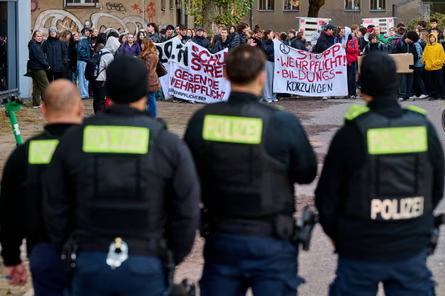
In Germany, a decentralized coalition known as Gen Z regelt (Generation Z is Sorting It Out) has mobilized supporters to rally in over 30 cities. The movement’s demands include increased funding for schools and housing, stronger climate protections, and opposition to proposals reinstating mandatory military service. Organizers have utilized social media to emphasize non-violence, stating, “Our protest is peaceful, without exception. Violence goes against everything we stand for.” More than 160,000 individuals registered interest via the group’s website by Friday.
Security preparations are underway, particularly in Berlin. Police Chief Barbara Slowik Meisel announced the deployment of an additional 1,500 officers but noted a lack of concrete evidence suggesting coordinated looting or attacks on property. Approximately 10,000 protesters, primarily students, pupils, and parents, are expected at the Brandenburg Gate, with smaller gatherings planned in the Mitte district. Major rallies are also scheduled for Cologne, Munich, Frankfurt, and Hamburg.
The political response has been mixed. Alexander Throm of the ruling Christian Democratic Union (CDU) urged preventive measures to avoid “scenes like those in France.” Conversely, Felix Banaszak, co-leader of the opposition Green Party, warned that preemptively branding the protests as gang violence could fuel radicalization. Meanwhile, the Federal Pupils’ Conference distanced itself from the Saturday events, citing organizational unpredictability, and instead plans its own demonstration in Berlin on November 20 focusing on declining educational standards.
France: Heavy Security Amid Radical Fears
Across the border, France faces a heightened threat assessment. Interior Minister Laurent Nuñez described Saturday as a “very high risk” day, deploying 70,000 police and gendarmes, including elite units, to maintain order. Authorities aim to suppress violence emanating from fringe groups rather than the main labor and student unions.
Nuñez highlighted that radical factions, including segments of the far-left and some gilets jaunes (Yellow Vests), had used social media to incite violent gatherings after official protest hours ended. He noted calls for “revolution” and pledged a zero-tolerance policy toward excesses. To mitigate risks, most demonstrations will be banned in city centers prone to disorder, though peaceful rallies elsewhere remain authorized. In Paris, two separate marches organized by unions and Yellow Vests through the capital’s core were prohibited; organizers are challenging this exclusion, which limits them to a single permitted march in the southeast.
Last Saturday, approximately 410,000 people marched in France. While a robust police presence largely prevented a repeat of the widespread looting seen during the initial wave of protests on October 17, tensions remain high. Unions, Yellow Vests, and students continue to coordinate, with a nationwide strike scheduled for November 5. Student leaders argue that government concessions—such as fixing university admission platforms and offering renovation loans to local authorities—are insufficient to address systemic issues.