Overview of the Alberta Secession Referendum and Prime Minister Carney’s Unity Speeches
Alberta held a vote on whether to initiate the process for a referendum on leaving Canada, with approximately 75% of voters ultimately supporting remaining in Canada and 25% supporting initiating the separation process. This vote was not a direct decision on independence, but rather a 'soft question' about whether to launch a future separation process. Canadian Prime Minister Mark Carney delivered multiple speeches before and after the referendum calling for national unity, emphasizing the strategic importance of energy pipeline construction to reduce dependence on the United States. Alberta Premier Danielle Smith welcomed the referendum results, promising not to hold another such referendum during her term, while stating she will continue to seek greater provincial autonomy within the Canadian framework. Although the separatist movement suffered a major setback, it vowed to continue promoting the idea of independence.
Background
- Legal background: According to a 1998 Supreme Court of Canada ruling, provinces cannot secede from Canada unilaterally, and any act of separation must involve negotiations with the federal government.ABCNEWS
- Geopolitical and economic background: Trump's trade war and threats to turn Canada into the '51st state' heightened external pressure on Canada, prompting Canadians to unite; at the same time, as the energy core, Alberta's pipeline construction is crucial for reducing dependence on the US and attracting foreign investors who focus on return on investment and regulatory predictability.BBC ABCNEWS
Key actors
Confirmed facts
- Alberta held a vote on whether to initiate the process for a referendum on leaving Canada, with approximately 75% of voters ultimately supporting staying in Canada and 25% supporting initiating the separation process (with 90% of voting areas reporting).ABCNEWS
- Prominent separatist leaders traveled to Washington three times last year to meet with US State Department officials to outline what an independent Alberta could offer.BBC
Claims and disputes
- Regarding the motivation of the 25% of voters who supported initiating the separation process: Carney and some analysts believe they do not necessarily want independence, but are dissatisfied with Ottawa; separatists argue this is an educational outcome and a step forward for the independence movement.ABCNEWS
- Regarding the timing and impact of the referendum: Some views suggest that engaging in internal conflict when the country faces external threats (such as Trump's trade war) is the worst possible timing; whereas separatists believe it is a necessary means to gain leverage and achieve lasting change.ABCNEWS ABCNEWS
- Foreign interest in domestic Canadian politics: Some points out that apart from the US, most foreign governments have little interest in Canadian domestic politics, with foreign investors focusing more on the timeline of infrastructure projects, return on investment, and predictable regulations.BBC
How sources covered it
- Focuses on the legal limitations of the referendum, historical background (such as the Freedom Convoy), polling data, and the initial reactions of the premier and separatists, emphasizing that separation is a 'long and uncertain process'.ABCNEWS
- Focuses on Carney's campaign-style speeches, geopolitical perspectives (US State Department contacts, foreign investor concerns), the strategic importance of energy pipelines in reducing dependence on the US, and the complex influence of the Trump factor on Canadian unity.BBC
- Focuses on the final results of the referendum (75% vs 25%), detailed reactions from various parties (including everyday voters and commentators), and the practical impact of the referendum on domestic Canadian politics and future federal-provincial relations.ABCNEWS
Reactions
- Separatists (such as David Parker, Jeff Rath, etc.) acknowledged defeat, feeling that independence 'still feels far off', but vowed to continue educating Albertans and driving the independence movement forward.ABCNEWS
- Everyday voters and commentators had mixed reactions: Janyce McGregor called it a 'win for Team Canada and its resilience'; some voters cast ballots in favor of starting the process merely to send a message of dissatisfaction to Ottawa; others criticized the referendum as a waste of money and worried about internal conflict.ABCNEWS
Impact analysis
- [Occurred] The referendum decisively rejected initiating the separation process by a vote of 75% to 25%, temporarily removing the immediate threat of Alberta seceding from Canada and consolidating national unity.ABCNEWS
- [Occurred] Premier Smith promised not to hold another such referendum during her term, pulling the separation dispute back into resolution within the Canadian political and legal system.ABCNEWS
- [Expected] Carney and Smith expressed intent to strengthen federal-provincial cooperation, with Alberta continuing to strive for greater autonomy within the Canadian framework.ABCNEWS
- [Expected] Although the separatist movement suffered a blow, gaining around 25% support on a 'soft question' shows that dissatisfaction with Ottawa remains and the movement will persist.ABCNEWS
Open questions
- How will Canada's national unity evolve once Trump is no longer president or no longer serves as a single rallying point for Canadians to 'unite around the flag'?BBC
- What are Alberta's specific demands for seeking 'greater provincial autonomy' within the Canadian framework, and how much room is there for federal concessions?ABCNEWS
- Among the 25% of voters who supported launching the separation process, how many truly desire independence versus how many simply wanted to express their dissatisfaction with Ottawa?ABCNEWS
Timeline
- Supreme Court ruling found that provinces cannot secede unilaterally.ABCNEWS
- The 'Freedom Convoy' began as a protest against the COVID-19 vaccine mandate and grew into weeks of demonstrations.ABCNEWS
- Prominent separatist leaders travelled to Washington three times to meet US State Department officials.BBC
- Canadian Prime Minister Mark Carney urged Alberta to remain in Canada in a Thanksgiving holiday message.ABCNEWS
- Mark Carney declared 'Vote like Canada depends on it' to cheering crowds in Calgary and commented that the pipeline 'will reduce our dependence on the United States'.BBC
- Donald Trump sent a signal north at a rally in Kansas.BBC
- At a separatist referendum night gathering at an Edmonton restaurant, the crowd fell quiet as results rolled in.ABCNEWS
- Mark Carney spoke with Danielle Smith about the results and greater federal-provincial cooperation.ABCNEWS
- Referendum results showed 75% support for remaining in Canada with 90% of voting areas reported; Mark Carney told reporters about the results before a Cabinet meeting in Ottawa.ABCNEWS
- Danielle Smith delivered a televised address welcoming the result and pledging not to hold another separation referendum.ABCNEWS
- Mark Carney pointed to 'unleashing our full potential as a global energy superpower with Alberta as its core' in his first statement after the vote.BBC
Related news
Alberta’s overwhelming yes vote strengthens Carney’s hand against Trump and at home Click to expand the full report Collapse full report
Preliminary results showing a large Alberta majority for remaining in Canada give Mark Carney domestic momentum to rebuild the economy and confront U.S. pressure, writes the BBC's Lyse Doucet.
Alberta's preliminary referendum result, in which more than two-thirds of voters backed continued membership in Canada, has handed Prime Minister Mark Carney a powerful mandate at home and abroad, the BBC's Lyse Doucet writes. The outcome followed Carney's appeal to cheering crowds in Calgary last week, where he declared, "Vote like Canada depends on it," on a stage covered in bright red and white Forever Canadian banners. The message appears to have resonated, and the overwhelming yes to staying in Canada now supplies Carney with political building blocks. The vote also matters because the federation's future still rests on Alberta, the country's richest province, which holds most of Canada's proven oil reserves and abundant gas and mineral wealth. It is central to Ottawa's effort to survive a punishing trade war with the United States by diversifying trade, strengthening the economy and forging new alliances on the other side of the world. Carney, a former central banker who grew up in Alberta, has become Canada's builder-in-chief at home and beyond its borders. The emphasis was notable: once the scale of Monday's separation-vote victory was clear, his first statement stressed, "They chose unity, to build together, and to take care of each other." Thomas Lukaszuk, a former lawmaker whose Forever Canadian campaign played a key role in the referendum outcome, addressed elated supporters in Edmonton, the provincial capital, as the yes count kept tumbling in. He warned, "Don't mess with Canada," and said the vote would send a very strong message to the rest of the world. Everyone understood the reference to the troublesome neighbour to the south, especially its president, who keeps threatening to turn Canada into the 51st U.S. state. On the same day Albertans voted, Donald Trump sent his own signal north at a rally in Kansas ahead of next month's U.S. midterm polls. He promised, "I will let you keep ice hockey, and I will let you keep your 'O Canada' national anthem," before adding, "We're only kidding." For Canadians, it is no laughing matter. In the run-up to the referendum, Carney repeated a warning he has often sounded: "there are some outside our borders who are working to break us, so they own us." He did not spell out who they were, and he did not have to. During a defining time for the separatist camp, some of its most prominent leaders did not hide their direction of travel; they admitted travelling to Washington three times last year to meet U.S. State Department officials and outline what an independent Alberta could offer, including a possible oil pipeline through the United States to the Pacific. The vote was historic for Canada and sparked conversations and concerns from coast to coast to coast, though the rest of the world may take only passing notice. Professor Janice Stein, founding director of the Munk School of Global Affairs and Public Policy at the University of Toronto, said that short of a vote to separate, most foreign governments except the United States have little interest in domestic Canadian politics. She added that foreign investors are focused on the time it will take to complete major infrastructure projects, a return on investment and predictable regulations, a nod to Carney's long list of megaprojects he hopes will eventually turbocharge economic growth. They are all costly, and many will take years to build. An ambitious blueprint already includes a proposed pipeline to the Pacific coast that opens opportunities for Alberta's oil to reach Asian markets. The move also addresses Alberta's long-standing grievance that its economy has been stifled by federal policies, including environmental regulations. At a rally in Alberta last week, Carney's comment that the pipeline "will reduce our dependence on the United States" triggered the loudest and longest applause of the night. After Monday's vote, Carney, the former UN Special Envoy for Climate Action and Finance, pointed to "unleashing our full potential as a global energy superpower with Alberta as its core." Political and economic pressures now seem to eclipse his green credentials. "Build Canada Strong" has been his mantra ever since he first entered politics as a complete neophyte at the start of last year. At home, the final tallies of the referendum's nine other questions could have wide-reaching repercussions. They dealt with issues ranging from greater provincial powers and the costs of immigration to potential constitutional changes. Those results are certain to provoke debate and deal-making or deal-breaking involving Canada's nine other provinces and three territories, all of which have their own grievances. Carney has had to defend himself when journalists ask whether he is spending too much time on foreign trips with a charm offensive to build new political alliances and trade partnerships, including an unprecedented and still uncertain offer of associate membership of the European Union. He recently replied with signature bluntness, "I can do both and I need to do both," before listing more than 16 bills that went through Parliament in the last session dealing with everything from major tax changes and public safety to the price of fuel. For now, Carney is riding high in the polls at home, including in Alberta, which does not traditionally support his Liberal party, and is enjoying a long "political honeymoon" that other beleaguered politicians would envy. The plain-speaking politician's strong and steady response to Trump threats, including retaliatory tariffs, has seen his star rising on the world stage. That is an unexpected turn for a country that has often been missing from top tables and has sometimes even been dismissed as "boring". The Economist magazine decided to put Carney on its cover during this week of weeks for Canada, showing a perfect red maple leaf between his teeth. One headline read, "Mark Carney shows middle powers how to handle a dangerous world," while the article also focused on Canada's "vulnerabilities", including Alberta's ballot. David Moscrop, a political scientist and author of the forthcoming book On Nationalism, said, "The broader takeaway from this vote might be that Canadian unity is in fine shape." But he asked, "But what happens after Donald Trump is gone and Canada no longer has a single, bombastic target which drives Canadians to rally around the flag?" Carney's decision to recently walk away from trade talks with the United States gave rise to another swell of Canadian pride and patriotism. Yet if this trade war drags on with a country that traditionally takes 70% of Canada's exports, Canadians will feel even greater pain in their daily lives. Still, today is a day to vigorously wave the maple leaf flag. CBC journalist Janyce McGregor said during the public broadcaster's rolling coverage, "It's a win for Team Canada and its resilience."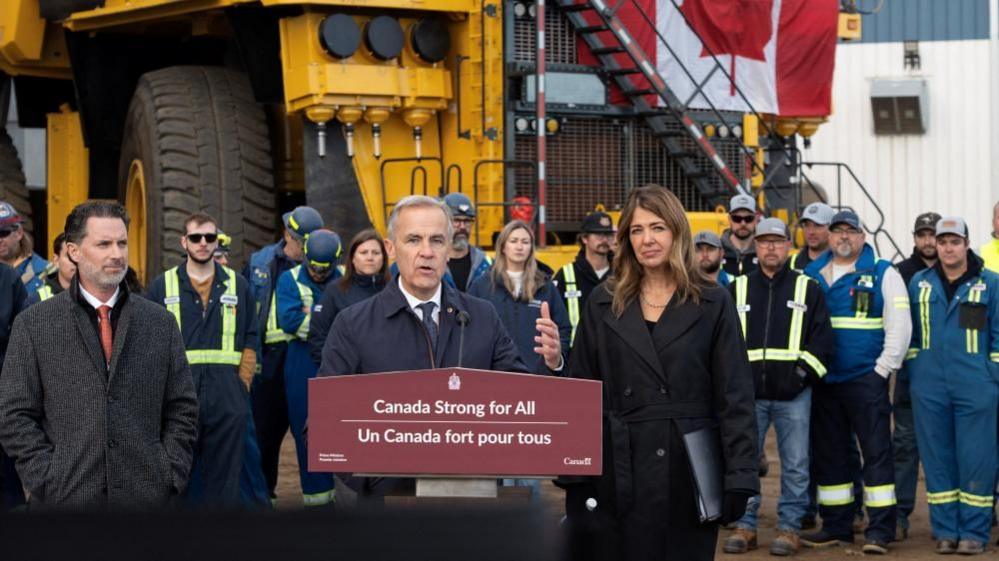
Albertans vote down launch of secession process, handing Carney a unity win Click to expand the full report Collapse full report
Unofficial results from Elections Alberta, covering 90% of voting areas with more than 1.9 million ballots counted, show 75% backed staying in Canada and 25% favored starting a separation process, prompting Premier Danielle Smith to rule out another referendum while in office.
Albertans have voted decisively against opening the door to leaving Canada, unofficial results from Elections Alberta showed Tuesday, handing Prime Minister Mark Carney a timely boost for his effort to hold the federation together at a time when U.S. President Donald Trump's trade war and annexation threats have pushed Canadians to close ranks around their country. With returns reported from 90% of voting areas and locations and more than 1.9 million ballots counted, 75% of voters had backed staying in Canada, while 25% favored starting a process toward separation, according to the unofficial tally. The ballot question did not directly ask whether Alberta should become independent. Had it passed, it would only have set the province on course for a future referendum on secession. Speaking to reporters in Ottawa ahead of a Cabinet meeting Tuesday, Carney welcomed the outcome. "It's a great result for Canada that Albertans have chosen unity," he said. The prime minister argued that the roughly one-quarter who voted to begin the separation process were not necessarily seeking independence, describing a smaller "hard core" as the ones who truly want to leave. Some participants, he suggested, mainly wanted to send Ottawa a message. No second referendum while Smith is premier Premier Danielle Smith, in a televised address Tuesday night, accepted the verdict and promised that no further referendum on separation would be held while she remains in office. "Yesterday, Albertans voted overwhelmingly in favor of remaining a province of Canada," Smith said. "The voter turnout was historic and a powerful testimony of the passion Albertans feel for our country and our province." She added that her government would keep pressing Ottawa for greater provincial autonomy, with disputes pursued through Canada's political and legal institutions rather than through exit. Carney said he spoke with Smith on Tuesday morning about the result and about deeper federal-provincial cooperation, including on immigration. Thomas Lukaszuk, a former Alberta deputy premier who led the anti-separation Forever Canadian campaign, had a blunt message for supporters: "Don't mess with Canada. President Trump is watching this." A marginal cause that refuses to fade Home to the world's fourth-largest proven oil reserves, Alberta is cowboy country — a conservative bastion whose political culture has long had more in common with the American West than with much of Canada. Resentment toward the federal government in Ottawa runs deep, though it has not historically translated into broad support for independence. Even in defeat, separatist leaders pledged to keep pressing for independence. David Parker, an organizer for the separatist side, conceded the scale of the loss. "Independence feels far away and we should not pretend this was not a defeat," he wrote on social media. Former premier Jason Kenney noted that separatist parties traditionally drew only 1% or 2% of the vote, and said anger over COVID-19 restrictions helped mobilize activists who later embraced the independence movement. Trump's trade war and his threats to make Canada the 51st U.S. state have helped Carney rally support in Alberta, where Liberal prime ministers have historically been unpopular. At a separatist referendum-night gathering at an Edmonton restaurant, the room went quiet as the returns came in. "We're not going anywhere," said Jeff Rath of the Alberta Prosperity Project. "We've dominated the conversation in the last year. We've been educating Albertans on the benefits of independence, and we're going to continue moving forward." Rath had said before the vote that 30% support would leave him thrilled. He also called for Smith to be ousted as UCP leader and predicted the party could splinter, potentially giving rise to a new pro-independence party. Ian Brodie, a political scientist at the University of Calgary and a former chief of staff to Conservative Prime Minister Stephen Harper, dismissed Rath and fellow organizer Mitch Sylvestre as "nobodies," noting they had failed to build momentum even in a district that elected a separatist to Alberta's legislature in 1982. "Even on a very soft question — whether to hold a referendum on separation — they couldn't gain real traction," Brodie said. How voters explain their ballots Shawn Campbell, who voted in Edmonton, said he cast his ballot to start the separation process even though he does not want Alberta to leave Canada. "It sends a message to Ottawa that Albertans are not happy," he said. Dave Malka, 59, of Edmonton, criticized spending money on a "referendum on a referendum" rather than on healthcare. With Trump threatening Canada, he added, "It seems to be happening at the absolute worst time when we should be united. Instead we're fighting among ourselves." Ali Khowaja, an Edmonton resident who immigrated to Canada six years ago, said he welcomed the outcome and was glad the province had chosen unity over a Brexit-style rupture. "Over the years, you've seen the consequences and what that meant," he said. "I was concerned, especially as someone who is an immigrant to Canada." Additional reporting by Ty ONeil in Wainwright, Alberta.